Bionic Hands Get Better as AI's Gas Bill Grows
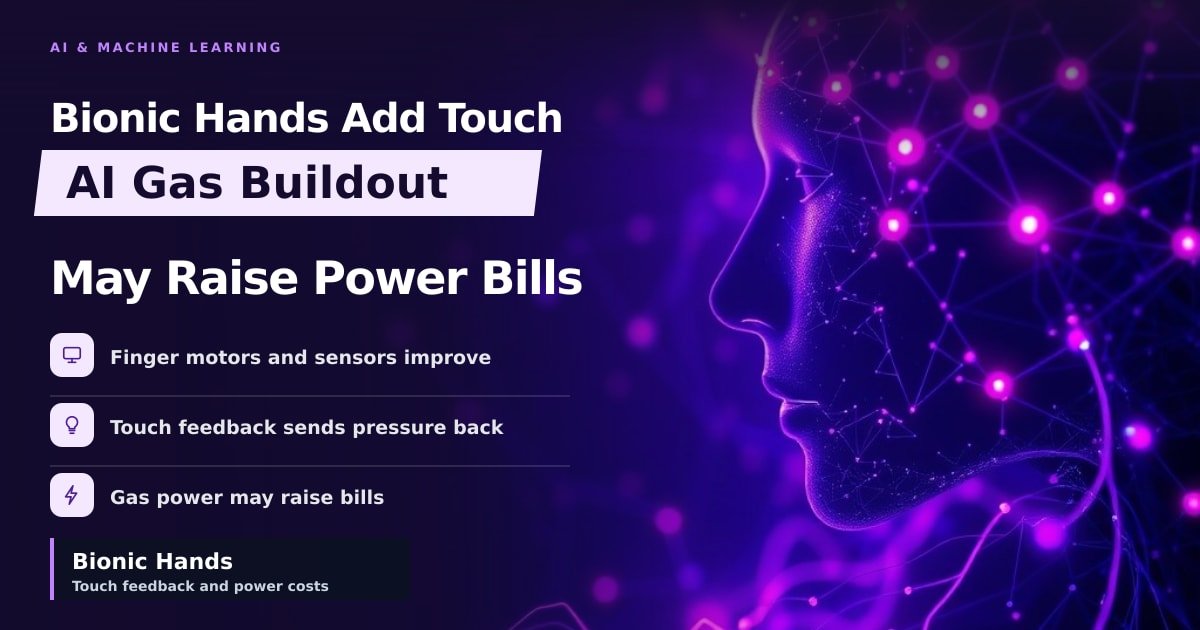
TL;DR: Powered bionic hands are getting closer to real ones, with better grip and touch feedback. At the same time, the data centers behind AI are leaning hard on natural gas, which means more emissions and possibly higher power bills.
The hardest test for a powered prosthetic hand isn't lifting a heavy box. It's holding a paper cup of coffee without crushing it, then letting go when you want. For decades, that small set of moves has been out of reach for most people who wear one.
What's actually new with bionic hands
Three things changed at once. Motors got small enough to sit inside each finger. Sensors got cheap enough to cover a fingertip. And the software that reads electrical signals from the muscles in your forearm got better at guessing what you mean to do.
Put together, that means a hand you can open just by thinking about opening it — plus a hand that sends something back, like a small buzz or a sense of pressure. Researchers call this feedback. You'd call it knowing the cup is actually in your hand.
Most of this still happens in short studies, and the hands stay expensive. But the direction matters. Prosthetics are shifting from "a tool you wear" to "a part you feel with."
Why AI runs on natural gas now
Training and running AI models eats electricity. A single data center — a warehouse-sized building packed with computers — can pull as much power as a small town. Solar and wind are cheap to build but slow to connect, because grids and batteries take years to sort out. A gas plant can go up in a few years and switch on whenever demand spikes.
So AI companies are signing deals with gas power producers. That's the "boom" you're seeing in headlines. AI doesn't burn gas itself; the electricity it needs increasingly comes from gas-fired plants.
Why both stories reach your wallet
Better prosthetics still cost tens of thousands of dollars, and insurance rules vary wildly from plan to plan. A lab breakthrough doesn't automatically reach the person who needs it. That gap is the real story.
On energy, demand from data centers is climbing after years of staying flat. Utilities building new plants tend to spread the cost across all customers, not just the tech firms. You may also see more pipelines and power plants closer to where you live.
What to watch next
Watch for home trials: people using these hands for months, not hours. That's the honest test. On the energy side, watch whether AI companies pair gas deals with carbon capture (systems that trap CO2 from smokestacks) or just promise to fix things later.
Key Takeaways
- Bionic hands are adding more motors, fingertip sensors and touch feedback.
- AI data centers need power fast, and gas plants are quicker to build than wind or nuclear.
- Both trends cost money, and both bills often land on ordinary people.
- Real proof comes from long home trials and from what gets built, not what gets promised.
Frequently Asked Questions
Can bionic hands feel things now?
Partly. Some experimental hands send pressure or vibration back into your arm, so you get a rough sense of touch. It's not the same as a natural hand.
Why is AI blamed for a natural gas boom?
AI data centers need large amounts of electricity quickly, and gas plants can be built and switched on faster than most alternatives.
Will AI data centers raise my electricity bill?
Possibly. Utilities that build new power plants often pass the cost to every customer, not just the companies behind the data centers.
Sources
- MIT Technology Review — https://www.technologyreview.com/
- WHO fact sheet on assistive technology — https://www.who.int/news-room/fact-sheets/detail/assistive-technology
- IEA, Electricity 2024 — https://www.iea.org/reports/electricity-2024
How did this story feel?
Be the first to react
AI assistance. This article was researched and drafted with AI tools and reviewed by our editorial team before publication. We link to sources at the end of every article so you can verify the claims. If you spot an error, please let us know.
Recommended gear
Related picks for this guide
ChatGPT Pro (2026)
GPT-5 · 1M token · canvas mode
Our pickView offer →GitHub Copilot Workspaces
GPT-4o · VS Code · PR review
Must‑haveView offer →Midjourney Web (turbo tier)
Turbo · 4K · 60 fps gen
Fastest renderView offer →Affiliate links: we may earn a commission at no extra cost to you.
Weekly tech brief
The tech stories worth your time, every Sunday.
One short email with the most useful guides and gadget picks from the week. No spam, unsubscribe anytime.
Written by
TechPulse TeamThe TechPulse editorial team publishes clear, practical technology guides. Every article is original and written to be understood — not just skimmed. Read our editorial policy.
Comments (0)
No comments yet — start the conversation!
Keep reading
New AI Wildlife App Helps Spot Illegal Products
A new smartphone app uses AI to spot illegal wildlife products. It could help shoppers and rangers, but accuracy and privacy questions remain.
AI Cattle Weighing App: Can a Phone Replace the Scale?
A new app uses AI to estimate cattle weight from a phone photo, cutting out the scale. Great for spotting trends, but not a replacement for a certified sale weight.
How to Verify AI Answers Before You Trust Them
Links under an AI answer look reassuring. Here's a 60-second routine for checking whether the sources actually say what the bot claims.