
Blue-Green Deployments in 2026: What Changed
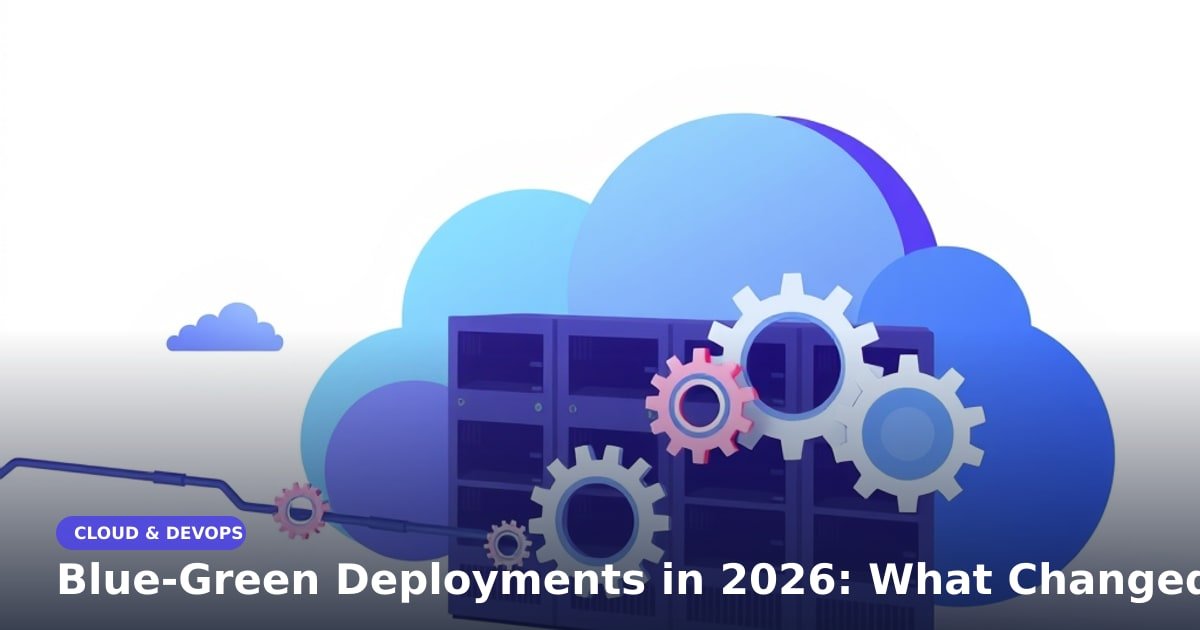
TL;DR: Blue-green deployments still work the same way at heart: run two copies of your app and switch traffic from the old one to the new one in a single step. What changed in 2026 is that the switch is now a config line, rollbacks happen on their own when error rates spike, and databases no longer force a maintenance window. You can get zero-downtime releases without a platform team.
Think about the last time a website broke while you were using it. The page half-loads, the login spinner never stops, and the checkout button does nothing. Someone deployed a change at the wrong moment, and nobody could undo it fast enough.
Blue-green deployments are the fix most engineering teams reach for now. Here's how they work, and what's genuinely new this year.
What blue-green actually means (in one minute)
Picture two identical hotel rooms. Guests are in room Blue. Housekeeping prepares room Green with the new furniture, tests it, then moves everyone across in one move. If something's wrong, you move them back. Nobody stands in the corridor.
In software, Blue and Green are two copies of your app running side by side. You send test traffic to Green, check it works, then point the load balancer (the traffic cop in front of your servers) at Green and stop sending traffic to Blue. Rolling back is one more flip — seconds instead of a stressful hour.
That's it. The idea was never the hard part.
What changed in 2026
The plumbing got boring, which is exactly what you want.
- Switching traffic is a config line. The Kubernetes Gateway API became the common way to route traffic across clouds and service meshes (the layers that connect your apps). Flipping 100% of traffic is now a small resource change, not a custom script someone wrote in 2019 that nobody understands.
- Rollback is automatic. Tools like Argo Rollouts and Flagger watch your error rate and response times during a release. If errors cross the threshold you set, traffic flips back without waking anyone up.
- Databases stopped being the blocker. This was always the real reason blue-green failed. Recent Postgres releases made logical replication (copying changes between two live databases) more reliable, and expand-and-contract migrations let two versions of your schema run at the same time. Tools like gh-ost still handle large MySQL tables without locking them.
- Two sets of servers no longer means two bills. Per-second billing, spot instances and scale-to-zero mean the idle copy can sit small and warm, then grow right before the switch.
Canary vs blue-green: which do you pick?
A canary release sends a small slice of real users, often 1% to 5%, to the new version while everyone else stays on the old one. It catches bugs that only show up with real traffic, like a payment provider that misbehaves for certain cards.
Blue-green gives you a clean, instant undo for the whole system. That's better when the change is big and risky: a framework upgrade, a new login flow, a database change.
Most teams I talk to now do both. Blue-green the infrastructure, canary the traffic, and use feature flags (switches that turn features on for specific users) for anything you might want to kill in ten seconds.
What this means for you
- Don't build the switching layer. If you're on AWS, Google Cloud, Azure or a platform like Vercel or Render, the traffic switch already exists. Use it.
- Spend your effort on the database. Nine out of ten "zero downtime" plans break at the migration step, not the server step.
- Test with real requests before the flip. One ping to your homepage isn't a smoke test. Hit login, checkout and your heaviest API endpoint.
- Watch the bill. Running two copies of a big system isn't free. Keep the standby small until minutes before cutover.
Key Takeaways
- Blue-green means two copies of your app and a one-step traffic switch.
- In 2026 the switch is a config change, and rollback can happen on its own.
- Database migrations are still where downtime sneaks in, so plan them first.
- Canary and blue-green work best together, not as rivals.
Frequently Asked Questions
Is blue-green deployment really zero downtime?
Yes, as long as your database can handle two app versions at once. Most outages blamed on blue-green are migration problems, not traffic-switching problems.
Does blue-green double my cloud costs?
Not anymore. The idle copy can run small and scale up just before the switch, and per-second billing means you only pay for the short overlap.
Do I need Kubernetes for blue-green deployments?
No. Any load balancer or platform that lets you point traffic at two versions will do. Kubernetes helps at scale, but a small team can manage without it.
How did this story feel?
Be the first to react
Recommended gear
Popular tech picks

Samsung Galaxy S25 Ultra
6.9" AMOLED · 200MP · 5000mAh
Editor's pickView on Amazon →
Apple MacBook Air 13-inch (M4)
M4 · 16GB · 13.6" Liquid Retina
Editor's pickView on Amazon →
Sony WH-1000XM5
Over-ear ANC · 30h battery
Best headphonesView on Amazon →Affiliate links: we may earn a commission at no extra cost to you.
Written by
TechPulse Team
The TechPulse editorial team publishes clear, practical technology guides. Every article is original and written to be understood — not just skimmed.
Comments (0)
No comments yet — start the conversation!
Keep reading
Learning From Outages: What SRE Teams Do Differently
Outages are lessons if you write them down. Here's how SRE teams turn a 2 a.m. failure into three concrete fixes, with no blame and no drama.
How a CI/CD Pipeline Catches Bugs Before Users Do
A CI/CD pipeline is an automatic checklist that runs on every code change. Here's how it catches bugs early, and the mistakes that quietly let them through.
What Are Logs? Why They Matter More Than You Think
Logs are the boring file that saves your site when it breaks. Here's what they are and why beginners should care.