
How Modern Cricket Leagues Run on Software (Not Spreadsheets)
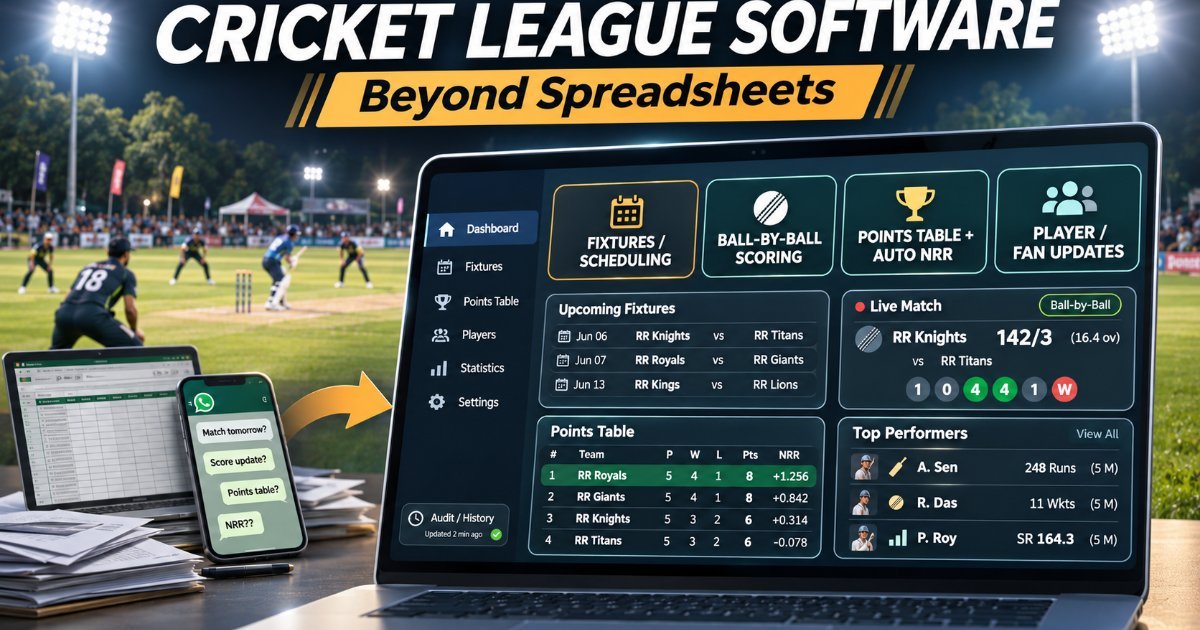
TL;DR: A cricket league is four jobs in a trench coat: scheduling, scoring, standings and communication. League software puts all four in one place, so results update once and everyone sees the same numbers. The biggest win is not flashy graphics. It is fewer disputes and fewer Sunday-night spreadsheets.
A local league organizer's Sunday night used to look like this: three versions of a fixture spreadsheet, a WhatsApp group arguing about net run rate, and a scorer's photo of a handwritten scorebook that nobody could read.
The cricket was fine. The administration was the problem.
That is the gap league management software fills. It is not just a scorecard app, and it is not just a website. It is the operating system of the tournament: the single source of truth for who plays whom, who scored what, and who sits where in the table.
The four jobs every league has to get right
Every competition, from a corporate six-a-side to a 12-team franchise league, has the same core jobs.
1. Scheduling. Who plays whom, when, on which ground, and with how many days between matches. A spreadsheet can hold this. It cannot easily catch a team playing twice at the same time.
2. Scoring. Ball-by-ball events: runs, extras, wickets, bowler changes. The scorecard is the raw material for everything else.
3. Standings. Points, wins, losses, ties, no-results, and net run rate. NRR is where manual systems usually fall apart.
4. Communication. Players need fixtures, venues, results and stats. Fans want the table and the top run-scorers. Organizers need both groups to see the same numbers.
When these live in four different places, every update becomes a small reconciliation project. A corrected score needs a new WhatsApp message, a new spreadsheet row and a new points table. Someone misses one, and the argument starts.
Why spreadsheets break at scale
Spreadsheets are brilliant for a one-off tournament. They become fragile when the league grows.
- Version conflicts. Two organizers edit the table; one copy wins, and nobody knows which.
- Manual NRR. One wrong all-out calculation changes the semifinal lineup.
- Duplicate players. The same person appears under two spellings, and the leading run-scorer is split in half.
- No audit trail. When a score is corrected, there is no record of who changed what or why.
- No live view. Fans wait for a WhatsApp update instead of watching the score move.
None of these are cricket problems. They are data problems. And data problems are exactly what software is good at.
What league management software actually does
A good platform connects the four jobs. The exact feature list varies, but the useful core looks like this:
- A fixture engine that publishes the schedule and updates it when a match is moved.
- A player registry with a unique identity per player, so stats follow the person across teams and seasons.
- Ball-by-ball scoring on a phone or tablet, including extras, wickets and undo.
- An automatic points table with NRR recalculated after every match.
- Season stats: runs, wickets, averages, strike rates, economy, boundary counts, dismissal patterns.
- Player auctions for franchise-style leagues, with sold and unsold records.
- Broadcast overlays and shareable scorecards for streams and social media.
- Fan-facing pages for fixtures, results, teams and leaderboards.
- Roles and permissions so scorers, team managers and admins see only what they need.
The best platforms also handle the boring edge cases: a match abandoned after eight overs, a player transferred mid-season, a score corrected two days later. That is where a real system earns its keep.
A useful example: WicketNexus
WicketNexus is one example of this category. It runs its own franchise league, the 2026 Premier Cricket League, and also licenses the platform to other organizers.
Its feature set matches the checklist above: live ball-by-ball scoring, a points table with automatic NRR, player and team directories, stats, a player auction, broadcast overlays and digital player IDs. It also offers a white-label tier, which means an organizer can put their own brand on the platform instead of sending players to someone else's site.
The plans are split by ambition: a free one-day trial, a starter plan for neighbourhood and corporate leagues, a pro plan for district and state-level competitions, and an elite plan for unlimited leagues with white-label branding. You can see the current details at wicketnexus.com.
The interesting part is not the price list. It is the model. The same software runs a league the company operates and a league a customer operates. That is only possible if the scoring and standings layers are genuinely reusable, not custom-built for one tournament.
What to look for before you choose
If you run a league, ask these questions before you commit:
- Does scoring work offline? Local grounds have weak networks. A scorer should be able to record a match and sync later.
- Is there an audit trail? Every correction should be traceable.
- Is NRR automatic and correct? Check the all-out rule with a test match before the season starts.
- Can players be uniquely identified? Names are not enough; duplicates ruin stats.
- Can you export your data? A league's history should not be trapped in a vendor's database.
- Do roles exist? A scorer should not be able to change team registrations.
- What happens after a match? Can you share a scorecard, overlay or table without rebuilding it by hand?
The bottom line
League software does not make cricket better. The players do that. What software does is remove the administrative tax that makes running a league exhausting.
When fixtures, scores and standings live in one place, organizers spend less time reconciling numbers and more time on the things that actually grow a league: better grounds, better coverage, and more teams wanting to join next season.
Key Takeaways
- A league platform is the single source of truth for fixtures, scoring, standings and communication.
- Spreadsheets fail at scale because of version conflicts, manual NRR and duplicate player records.
- The most valuable features are offline scoring, an audit trail and automatic NRR, not flashy graphics.
- WicketNexus is a working example that runs its own league and licenses the same platform to other organizers.
Frequently Asked Questions
Do I need league software for a small tournament?
No. For a one-weekend event, a spreadsheet and a shared scorecard can work. Software starts paying off when you have multiple rounds, repeat seasons, or more than one person updating results.
Can league software work without internet at the ground?
Good ones can. The scorer records on the device and the app syncs when a connection returns. Ask about offline mode before you rely on it.
Is net run rate calculated automatically?
On a proper platform, yes. The table should update after every match, including the all-out rule. Always test it with a known example before the season.
How did this story feel?
Be the first to react
Recommended gear
Popular tech picks

Samsung Galaxy S25 Ultra
6.9" AMOLED · 200MP · 5000mAh
Editor's pickView on Amazon →
Apple MacBook Air 13-inch (M4)
M4 · 16GB · 13.6" Liquid Retina
Editor's pickView on Amazon →
Sony WH-1000XM5
Over-ear ANC · 30h battery
Best headphonesView on Amazon →Affiliate links: we may earn a commission at no extra cost to you.
Written by
TechPulse Team
The TechPulse editorial team publishes clear, practical technology guides. Every article is original and written to be understood — not just skimmed.
Comments (0)
No comments yet — start the conversation!
Keep reading
Why Your Favorite Apps Keep Changing
Your app moved a button and you're annoyed. There's a real project behind that change — a test, a number, and sometimes a team that later reverses it.
Feature Prioritization: How a Real App Picks What Ships Next
A six-person app team had three weeks and three big requests. They shipped none of them. Here's what won instead, and how your feedback shapes the list.

Harvard blind navigation app: faster, safer walks
Harvard researchers reportedly built a smartphone app that helps blind users navigate faster with fewer collisions. Promise is real, but the evidence is early.