
Net Run Rate Explained: How NRR Really Decides a Cricket Table
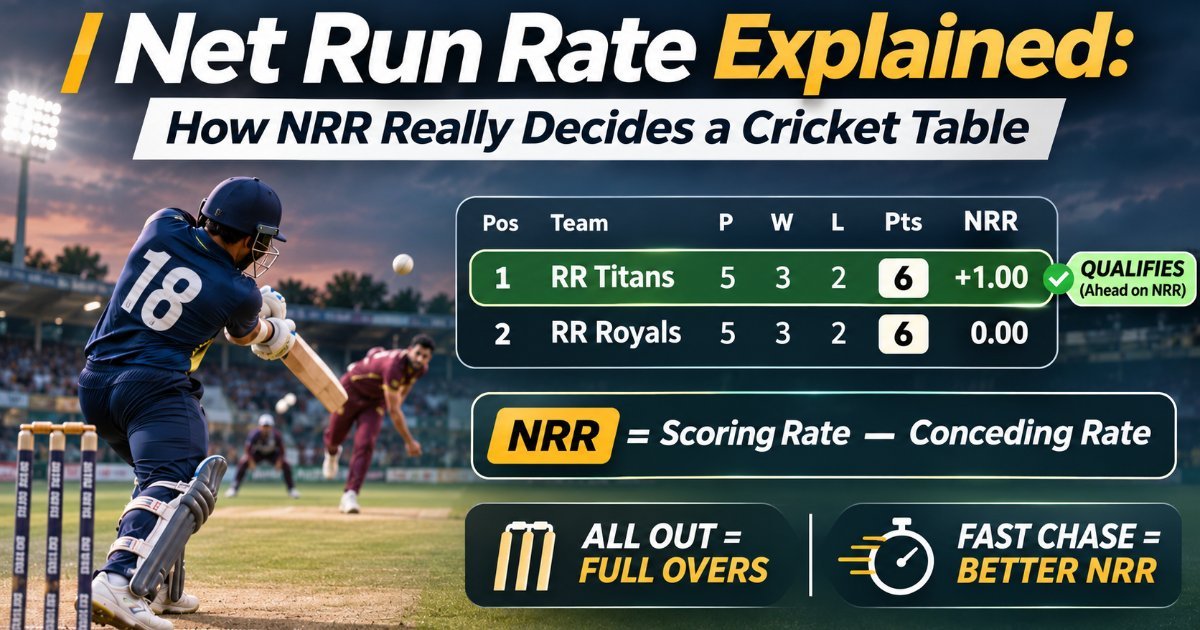
TL;DR: Net run rate is your scoring rate minus your conceding rate. The part most fans miss: if a team is bowled out, the calculation uses its full over quota, not the overs it actually batted. That one rule can decide who reaches the semifinal.
Two teams finish on the same points. One goes through. The other spends the evening explaining that head-to-head does not apply in this tournament.
Net run rate is often the difference. It is a simple idea with two rules that catch people out: the all-out rule and the fact that NRR is calculated across the whole competition, not averaged match by match.
The formula in one line
Net run rate = (total runs scored divided by total overs faced) minus (total runs conceded divided by total overs bowled).
For a single match, that is runs per over scored minus runs per over conceded. Across a tournament, add up all runs and all overs first, then divide. Do not average the NRR from each match. That can produce a different number.
A worked example
Team A scores 160/6 in 20 overs and concedes 140/8 in 20 overs.
- Scoring rate: 160 divided by 20 = 8.00 runs per over.
- Conceding rate: 140 divided by 20 = 7.00 runs per over.
- NRR: 8.00 minus 7.00 = +1.00.
Team B scores 150/7 in 20 overs and concedes 150/6 in 20 overs.
- Scoring rate: 150 divided by 20 = 7.50.
- Conceding rate: 150 divided by 20 = 7.50.
- NRR: 0.00.
Team A's rate is higher. Over a tournament, that difference can separate teams that finish on the same points. The margin and the overs used both matter.
The all-out rule
This is the rule that causes most arguments.
If a team is bowled out before its overs are complete, NRR treats it as having batted its full quota. Suppose a team is 120 all out in 16 overs in a 20-over match. Its scoring rate for NRR is 120 divided by 20 = 6.00, not 120 divided by 16 = 7.50.
Why? The rule is designed to stop a team from protecting its run rate by getting bowled out quickly. The full quota is the fairest common denominator.
The same applies to the team batting second. If it is bowled out in 17 overs, the calculation uses the full 20 overs.
When the chase ends early
If a team chases a target in 18 overs, its scoring rate uses 18 overs, not 20. That is why a quick chase can be worth more than a comfortable one.
Suppose Team C chases 150 in 18 overs for the loss of four wickets. Its scoring rate is 150 divided by 18 = 8.33. The same target in 20 overs would be 7.50. The extra 0.83 can be decisive in a tight table.
Run difference is not NRR
A 100-run win sounds better than a 40-run win, but NRR cares about overs too.
- Winning by 100 runs in 50 overs: roughly +2.00 per over.
- Winning by 40 runs in 30 overs: roughly +1.33 per over.
- Winning by 10 runs in 20 overs: roughly +0.50 per over.
The margin matters, but so does how long it took. A big win in fewer overs is more valuable than the same margin in more overs.
Where NRR actually decides things
NRR is usually a tiebreaker in group stages, triangular series and franchise leagues. Competition rules vary: some use head-to-head first, some use NRR first, and some use a Super Over. Always read the playing conditions.
It also affects tactics. A team that needs a big NRR swing may bat more aggressively or bowl for a smaller margin. That can lead to strange-looking decisions, but they are rational within the rules.
The mistakes that change the table
- Using actual overs for an all-out team instead of the full quota.
- Averaging match NRRs instead of aggregating runs and overs.
- Forgetting that a no-result is usually excluded from NRR.
- Mixing 20-over and 50-over matches in one table.
- Rounding too early. Keep two or three decimal places until the final table.
How software gets it right
A league platform calculates NRR from the same ball-by-ball data that produces the scorecard. When a result is corrected, the table recalculates. That removes the most common source of disputes: a human updating a spreadsheet after a long day at the ground.
WicketNexus, for example, advertises a points table with real-time NRR as part of its league platform. The value is not the formula itself. It is that the formula runs on every result, every time. You can see the setup at wicketnexus.com.
How to improve your NRR
- Win first. NRR is a tiebreaker, not a trophy.
- Bat aggressively in the powerplay if your team has the wickets to spare.
- Bowl for dot balls, not just wickets. Pressure creates both.
- Chase quickly when the target is modest, but do not throw away a win for a bonus point.
- Know the table before the last match. Sometimes a 20-run win is enough; sometimes you need 40.
Key Takeaways
- NRR = runs scored per over minus runs conceded per over, aggregated across the competition.
- An all-out team is treated as having faced its full over quota.
- A quick chase uses the actual overs, which can boost NRR.
- Do not average match NRRs; add runs and overs first.
- Software removes the arithmetic errors, but the playing conditions still decide tiebreakers.
Frequently Asked Questions
Is NRR calculated on the full 20 overs if a team is all out?
Yes, for the team that is all out. The calculation uses the full quota it was entitled to, not the overs it actually faced.
Does a no-result match affect NRR?
Usually no. Runs and overs from abandoned matches are excluded. Check the competition's playing conditions.
Can NRR be negative?
Yes. If a team concedes runs faster than it scores them, its NRR is below zero.
Is net run rate the same as run rate?
No. Run rate is runs per over for one team. Net run rate is the difference between a team's scoring rate and its conceding rate.
How did this story feel?
Be the first to react
Recommended gear
Popular tech picks

Samsung Galaxy S25 Ultra
6.9" AMOLED · 200MP · 5000mAh
Editor's pickView on Amazon →
Apple MacBook Air 13-inch (M4)
M4 · 16GB · 13.6" Liquid Retina
Editor's pickView on Amazon →
Sony WH-1000XM5
Over-ear ANC · 30h battery
Best headphonesView on Amazon →Affiliate links: we may earn a commission at no extra cost to you.
Written by
TechPulse Team
The TechPulse editorial team publishes clear, practical technology guides. Every article is original and written to be understood — not just skimmed.
Comments (0)
No comments yet — start the conversation!
Keep reading

How to Automate Boring Tasks on Your Computer
Free tools already on your computer can rename files, open your work apps and type your emails for you. Here's where to start.

Free Blog Hosting: Your Blog Live in One Evening
A real blog, live tonight, for nothing. Here's the exact six-step build using Hugo and a free host, plus what it really costs after year one.

Parental Controls That Respect Your Kid's Privacy
Skip the spy apps. Here's how to set real limits on your kid's phone using the free tools already inside iPhone and Android.