
Object-Oriented vs Functional: Which Thinking Fits You?
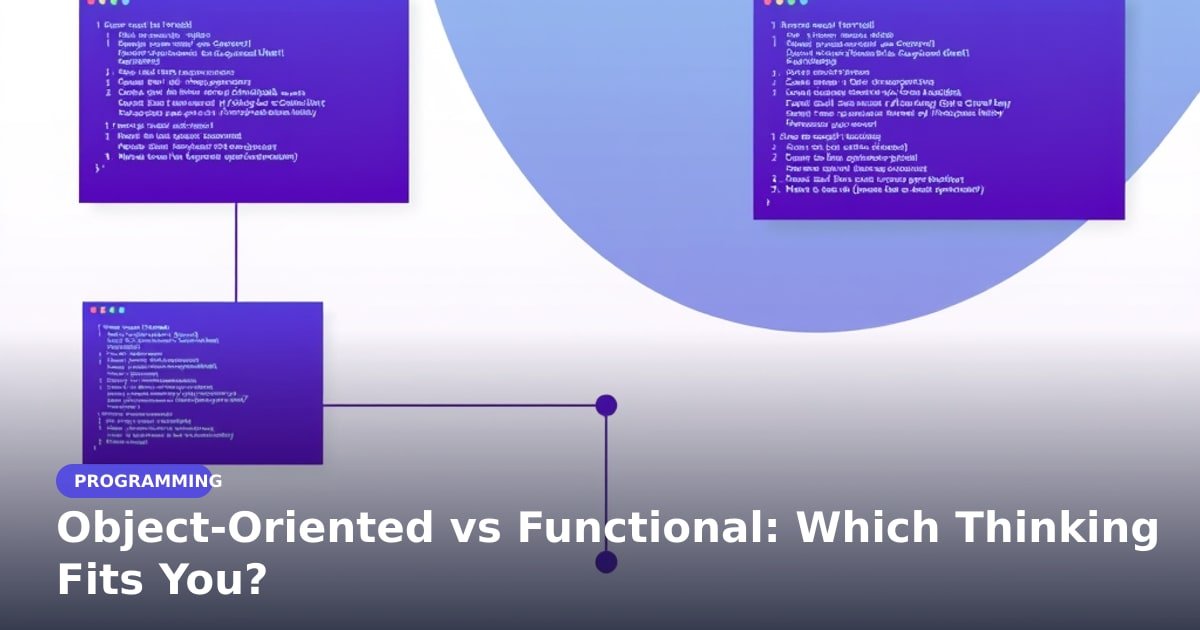
TL;DR: Object-oriented programming organizes code around "things" (like a User or a Product), while functional programming organizes code around "actions" (like calculate or filter). Most modern developers use a mix of both, but understanding the difference helps you write cleaner code and spot bad advice online.
Imagine you're organizing your kitchen. You could group everything by object: a drawer for knives, a shelf for plates, a rack for spices. Or you could group things by action: a station for chopping, a station for plating, a station for seasoning.
That's the real difference between object-oriented and functional thinking. It's not about syntax or tools. It's about how you sort the chaos.
The object-oriented approach: everything is a "thing"
Object-oriented programming (OOP) asks you to model your code like the real world. You create a "class" (think of it as a blueprint) and then build "objects" from it.
Here's a concrete example. If you're building a coffee shop app, you might create a Coffee class. It has properties like size and temperature. It has methods (actions) like brew() or addMilk(). Every cup you sell is a separate object built from that same blueprint.
The upside is intuition. You can point at your code and say, "That's the customer. That's the order. That's the receipt." It maps neatly to how we talk about business problems.
The downside is baggage. Change one small thing in the blueprint, and you might accidentally break five other objects that were relying on it. This is why large OOP codebases often feel like a Jenga tower.
The functional approach: think in verbs, not nouns
Functional programming (FP) flips the script. Instead of modeling "things," you model "transformations."
You have data going in. You have data going out. You have small, pure functions that do one job and never touch anything else.
A "pure function" is simple: give it the same input, and it always returns the same output. It doesn't secretly change a global variable or save something to a database behind your back. It's a calculator, not a dealmaker.
This is huge for testing and debugging. If a function is pure, you can test it in isolation without setting up a fake database or a fake user. You just pass in numbers and check the result.
In our coffee shop example, functional thinking wouldn't create a Coffee object. It would create a calculatePrice(size, extras) function. That function takes data, does math, and returns a number. It doesn't remember yesterday's coffee. It doesn't care.
What this means for you
If you're learning to code, this debate can feel like a trap. Which one is "right"?
Here's the honest answer: neither. The trend in modern software (React for websites, Swift for iPhones, even Java) is toward mixing them.
- Choose OOP when you have complex things with lots of moving parts. A video game character with health, inventory, and position? That's an object.
- Choose functional when you're processing data. Filtering a list of emails, converting currency, or formatting a date? Those are pure functions.
- Avoid the dogma. If someone tells you "OOP is dead" or "functional is the only real way," they're selling a book. Real codebases are messy and use both.
Key Takeaways
- OOP groups code by things (nouns); functional groups code by actions (verbs).
- Use OOP for complex items with state (like a shopping cart).
- Use functional for data processing and math (like calculating tax).
- Most modern code mixes both, so learn the mindset, not just the syntax.
Frequently Asked Questions
Is functional programming harder to learn?
Not inherently. The math terminology (monads, functors) scares people off, but the core idea is simple: trust functions that don't lie. Start with map, filter, and reduce in JavaScript or Python.
Can I use functional programming in Python?
Yes. Python supports functional style (lambdas, list comprehensions), but it doesn't force it. You can write a pure function in Python just as easily as in Haskell. The language won't stop you; your discipline will.
Which is better for getting a job?
Java and C# (heavy OOP) still dominate enterprise hiring. But React and modern JavaScript (which lean functional) are huge in startups. Knowing both makes you flexible. Don't pick a side before you've tried the other.
How did this story feel?
Be the first to react
Recommended gear
Popular tech picks

Samsung Galaxy S25 Ultra
6.9" AMOLED · 200MP · 5000mAh
Editor's pickView on Amazon →
Apple MacBook Air 13-inch (M4)
M4 · 16GB · 13.6" Liquid Retina
Editor's pickView on Amazon →
Sony WH-1000XM5
Over-ear ANC · 30h battery
Best headphonesView on Amazon →Affiliate links: we may earn a commission at no extra cost to you.
Written by
TechPulse Team
The TechPulse editorial team publishes clear, practical technology guides. Every article is original and written to be understood — not just skimmed.
Comments (0)
No comments yet — start the conversation!
Keep reading
How to Pick Your First Programming Language
Stop comparing languages for weeks and quitting in month two. Pick by what you want to build, then test it in one weekend.
Data Structures Examples You Already Use Every Day
Your music queue, undo button, and contact search are all data structures in disguise. Here's how to spot them and pick the right one for the job.
How Regular Expressions Work Under the Hood
Regex is a state machine, not magic. Here's how engines match text — and why a five-character pattern can freeze your server.