Why Screen Brightness Outdoors Beats Resolution
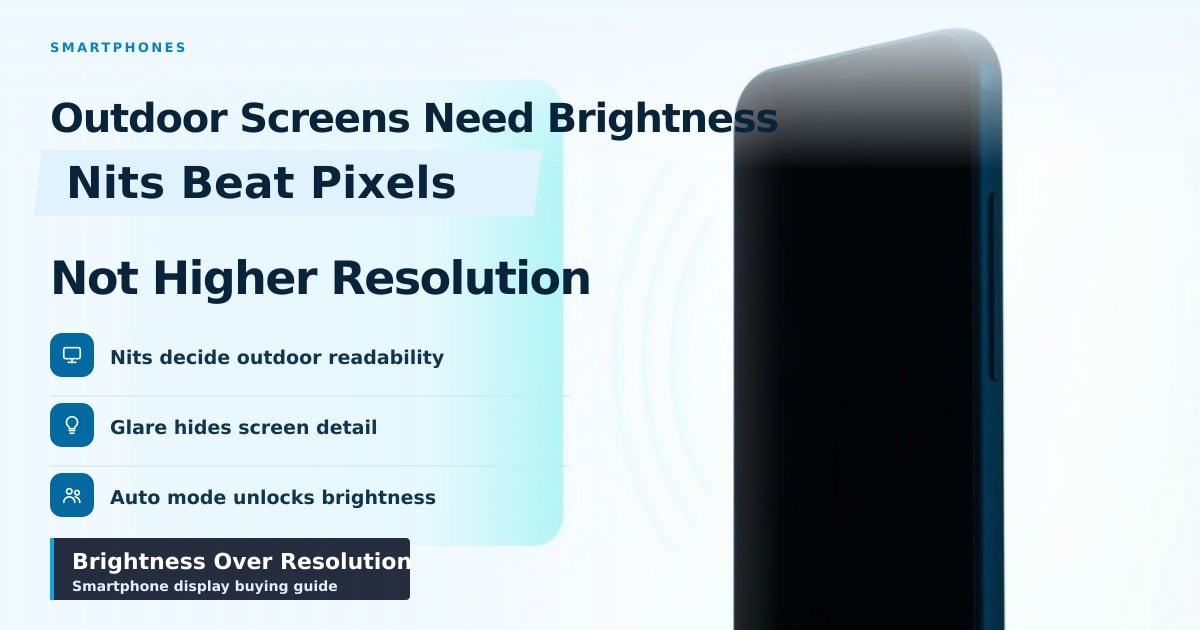
TL;DR: In direct sunlight, a bright screen beats a sharper one every time. Pixels you can't see don't help you, but glare you can't fight makes a phone useless. If you read outdoors a lot, buy for brightness and anti-glare, not for the resolution on the spec sheet.
At 1pm on a sunny street, two phones sit side by side on a café table. One has a 1440p flagship display. The other is a cheaper 1080p model with a brighter panel. Only one of them is readable without cupping a hand over the glass.
What screen brightness outdoors really means
Brightness is measured in nits, which is simply a unit of light. Your phone on a dark sofa might run at 2 nits. A sunlit pavement at noon throws about 30,000 nits at your eyes, so the screen needs serious output just to compete.
Here's the catch. The big number on the box is peak brightness, measured on a small patch of screen for a few seconds. Full-screen brightness during normal use is usually lower.
Auto-brightness does the heavy lifting. A light sensor tells your phone how hard to push. Leave brightness locked at 40% and even a bright panel will look washed out in the sun.
Why extra resolution doesn't fix glare
Resolution means pixels per inch (ppi) — how many colour dots fit into one inch of screen. A 6.1-inch phone with a 1080p panel already packs roughly 450 ppi. Held at the 30cm you normally use, your eyes can't tell those dots apart.
The problem outdoors isn't sharpness. It's reflection. Sunlight bounces off the glass and straight back into your eye, and everything on screen fades behind that sheet of glare.
A 1440p screen with a shiny coating can look worse on a park bench than a 1080p one with a matte finish.
The specs that actually help in sunlight
- High peak brightness in auto mode. Look for 1,500 nits or more on flagships, 1,000+ on mid-rangers. That's the gap between squinting and reading.
- An anti-reflective layer. Corning's Gorilla Armor, used on the Galaxy S24 Ultra, cut reflections noticeably in lab tests. Several brands now market similar coatings.
- A matte screen protector. Cheap glossy protectors add a second reflective surface on top of your screen.
- Light mode for text. Dark mode looks cool, but black text on a white background wins in bright sun.
What this means for you
If you read, navigate or shoot photos outdoors a lot, spend on brightness and glare handling, not pixel count. Apple rates the iPhone 16 Pro at 2,000 nits peak outdoors. Google quotes 3,000 for the Pixel 9 Pro. Both are 1080p-class at arm's length, and both stay readable at noon.
Don't pay extra for a 1440p panel on a 6-inch phone unless you watch a lot of video up close. Put that money toward a phone that holds its brightness, or a good matte protector.
Test it before you buy. Take the display model to a window and toggle auto-brightness off and on. You'll see the difference in ten seconds.
Key Takeaways
- Nits (brightness) decide whether you can read outdoors; resolution barely matters.
- Advertised peak brightness is higher than what you get across the whole screen.
- Anti-reflective coatings beat extra pixels in direct sun.
- Skip the 1440p upgrade; buy brightness and a matte protector instead.
Frequently Asked Questions
Does higher resolution make a phone easier to read in sunlight?
No. Above roughly 400 ppi your eyes can't resolve the extra detail at normal viewing distance. Glare is what blocks your view.
How many nits do I need to use my phone outdoors?
Aim for 1,000 nits or more in auto mode for comfortable use. Flagships now reach 2,000–3,000 nits peak, which helps most in direct midday sun.
Why does my phone screen look dim outside even at full brightness?
Likely your brightness is locked manually, or the phone is throttling to stay cool. Turning on auto-brightness usually unlocks the extra headroom.
Sources
How did this story feel?
Be the first to react
AI assistance. This article was researched and drafted with AI tools and reviewed by our editorial team before publication. We link to sources at the end of every article so you can verify the claims. If you spot an error, please let us know.
Recommended gear
Related picks for this guide
Samsung Galaxy S25 Ultra
6.9" AMOLED · 200MP · 5000mAh
Editor's pickView on Amazon →
Google Pixel 9a
6.3" OLED · Tensor G4 · 7-year updates
Best valueView on Amazon →Affiliate links: we may earn a commission at no extra cost to you.
More on #smartphone displays
Weekly tech brief
The tech stories worth your time, every Sunday.
One short email with the most useful guides and gadget picks from the week. No spam, unsubscribe anytime.
Written by
TechPulse TeamThe TechPulse editorial team publishes clear, practical technology guides. Every article is original and written to be understood — not just skimmed. Read our editorial policy.
Comments (0)
No comments yet — start the conversation!
Keep reading
Metro's Free Samsung Phone Deal: What You Actually Pay
Metro is giving away a Samsung phone for a limited time. The upfront price is zero, but the plan and lock terms decide whether you actually save money.
Xiaomi 18 Pro Review: What We Actually Know
A Xiaomi 18 Pro review is circulating without a single confirmed spec or price. Here's what's real, what's missing, and what to wait for.
Why Phone Speakers Are Getting Worse in 2026
Thinner phones and bigger batteries squeezed the air out of speaker boxes this year. Here's why your next phone sounds flat, and what to check before buying.