AI Mosquito Surveillance Now Fits in a Phone Camera
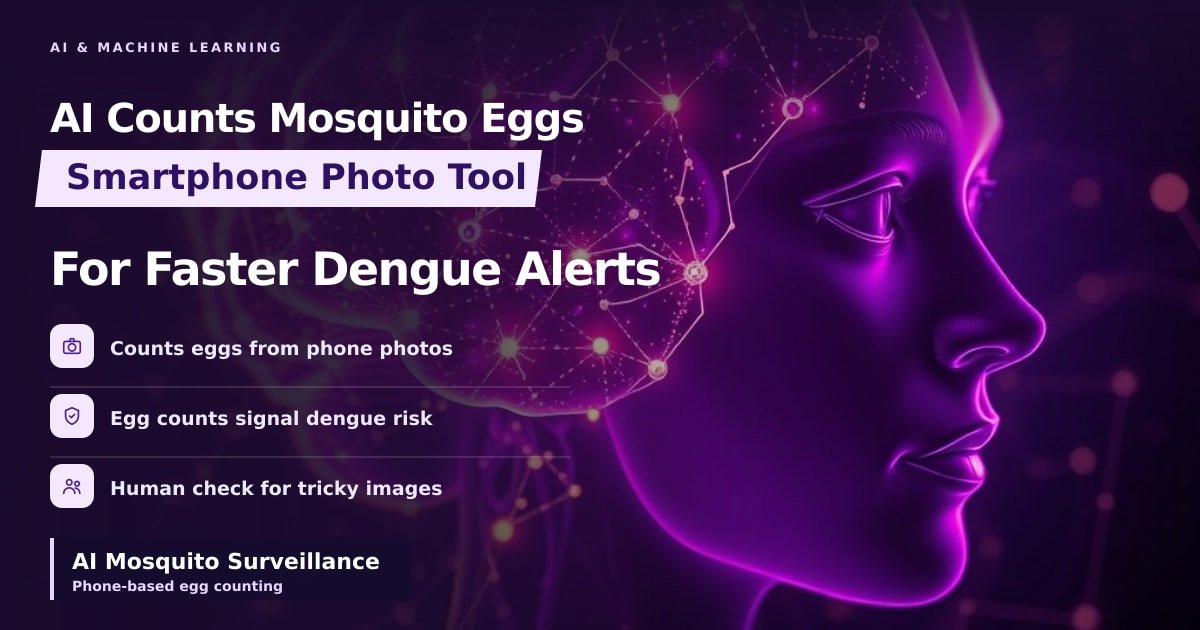
TL;DR: A new AI tool counts mosquito eggs straight from smartphone photos, which turns a slow microscope job into a quick snap and upload. It could help health teams spot dengue risk earlier and cheaper. It won't replace mosquito control, but it makes the warning step much easier.
An Aedes mosquito egg is about a millimetre long — a dark speck stuck to a stick that you'd rinse off without a second look. For decades, someone has had to count those specks by eye, one at a time, under a microscope. This week's report describes a tool that hands that job to a phone camera and a trained AI model.
What's actually happening
Health teams already set out small traps called ovitraps: black cups of water with a rough paddle standing inside. Female Aedes mosquitoes, the kind that spread dengue, lay eggs just above the waterline. Staff collect the paddle and count the eggs under a microscope to judge how many mosquitoes are breeding nearby.
The new tool replaces the microscope step with a photo. You snap the paddle, and the AI model (a program trained on labeled examples) finds each egg and returns a count. Details on cost, accuracy and release are still thin, so treat this as a research milestone rather than something your local clinic uses next week.
Why this matters to you
Dengue and similar viruses put people in hospital and cost families real money. Egg counts act as an early alarm: if numbers climb in one neighborhood, the control team can spray, clear standing water and warn residents before cases rise.
Counting by microscope is the bottleneck. One trained person can only get through so many paddles a day. A phone photo means community workers, students or volunteers can collect samples without a lab bench. More samples per week means finer maps, so you learn which streets need help instead of guessing at whole districts.
The honest catch
Eggs are tiny, dark and often bunched together. Harsh sunlight, a smudged lens or eggs stacked on each other can confuse any model. The tool also has to tell Aedes eggs apart from other mosquitoes, or it will overstate the risk in an area.
So expect these systems to work as a fast first pass, with a human checking the tricky images. That's still a win. If the AI flags a sample, a technician spends time there instead of flipping through hundreds of boring ones.
What to watch next
Three things decide whether this reaches your neighborhood. First, accuracy on real, grimy paddles rather than clean lab samples. Second, offline mode, because traps often sit in spots with weak mobile data. Third, a clear rule on the location data attached to each photo — save where a sample was taken and you've built a map of homes and yards.
Watch adoption too. If the software and phone time stay cheap, small local clinics can run surveillance they currently skip entirely. That's the part with the biggest payoff for public health.
Key Takeaways
- An AI tool now counts mosquito eggs from smartphone photos instead of microscope slides.
- Egg counts are an early warning system for dengue and similar mosquito-borne diseases.
- Phone photos let far more people collect samples, which means faster, more local alerts.
- Real-world accuracy, offline use and location privacy are the open questions.
Frequently Asked Questions
How does the AI count mosquito eggs from a photo?
It scans the image for tiny dark oval shapes matching eggs on a trap's paddle, then totals them up. A person still checks photos the model is unsure about.
Why do health workers count mosquito eggs at all?
Egg numbers reveal how many mosquitoes are breeding nearby. A sudden jump in one area is an early signal that dengue risk is rising.
Can I use this to check my own backyard?
Not yet, since no public app has been announced. The simplest step now is emptying standing water from pots, buckets and drains once a week.
Sources
How did this story feel?
Be the first to react
AI assistance. This article was researched and drafted with AI tools and reviewed by our editorial team before publication. We link to sources at the end of every article so you can verify the claims. If you spot an error, please let us know.
Recommended gear
Related picks for this guide

ChatGPT Pro (2026)
GPT-5 · 1M token · canvas mode
Our pickView offer →GitHub Copilot Workspaces
GPT-4o · VS Code · PR review
Must‑haveView offer →Midjourney Web (turbo tier)
Turbo · 4K · 60 fps gen
Fastest renderView offer →Affiliate links: we may earn a commission at no extra cost to you.
More on #ai
Weekly tech brief
The tech stories worth your time, every Sunday.
One short email with the most useful guides and gadget picks from the week. No spam, unsubscribe anytime.
Written by
TechPulse TeamThe TechPulse editorial team publishes clear, practical technology guides. Every article is original and written to be understood — not just skimmed. Read our editorial policy.
Comments (0)
No comments yet — start the conversation!
Keep reading
AI Transcription Accuracy With Accents and Noise
Accents aren't the real enemy of AI transcription — bad audio is. Here's what the trends mean and the two-minute fixes that cut your error rate.

OpenCode Browse: What a Web-Savvy AI Coder Means for You
A free AI coding tool just got the ability to check the web instead of guessing. Here's what changes — and what it costs you in privacy.

AI Replacing Smartphones? Qualcomm's CEO Says Not Yet
Qualcomm's CEO says AI won't replace your phone soon. Here's why that's good for your wallet and privacy — and what to watch before your next upgrade.