
Cyril Hilsum, Flat-Panel Display Pioneer, Dies at 101
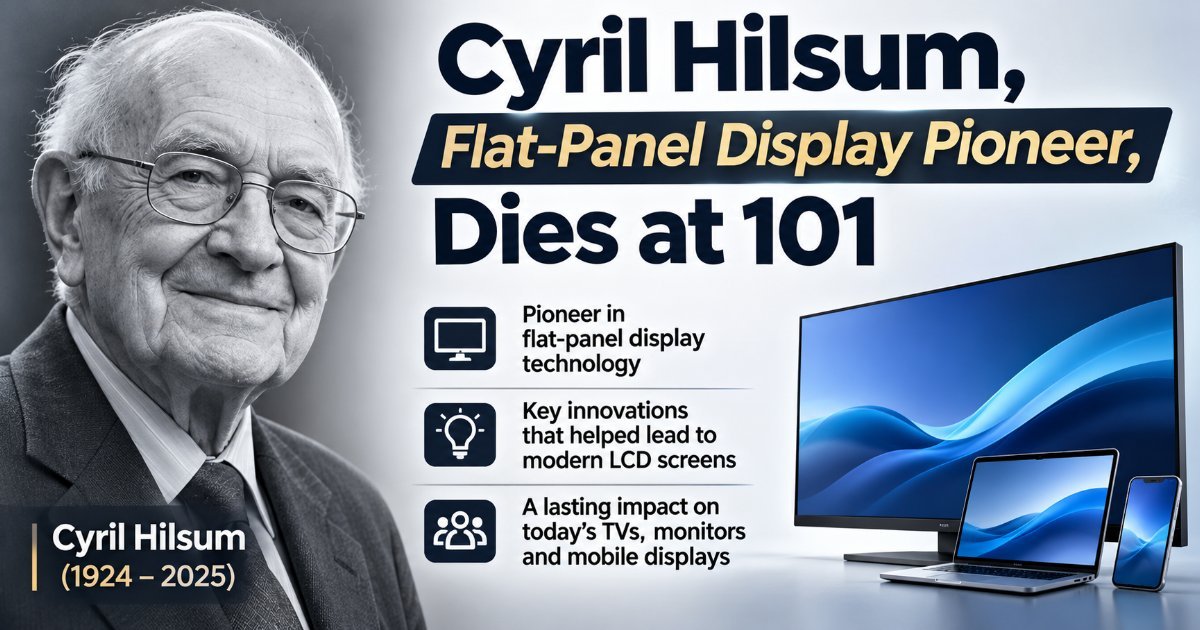
The screen you're reading this on has an ancestor most people have never heard of. It came out of a British lab in the 1960s, when a "flat" television sounded like science fiction and the cathode-ray tube looked unbeatable. Cyril Hilsum, one of the physicists who spent decades pushing that flat idea until it became the thing we all stare at, has died at 101.
You almost certainly own several of his descendants. The TV on the wall, the laptop on your knees, the phone in your hand — they all run on display technology that Hilsum and his colleagues argued for when the rest of the industry thought they were chasing a dead end.
What Cyril Hilsum actually built
Hilsum was a semiconductor physicist by training, and his career ran through the institutions that shaped postwar British electronics: Standard Telecommunication Laboratories in Harlow, then the GEC Hirst Research Centre, where he eventually served as chief scientist.
His fingerprints are on several strands of modern electronics:
- Compound semiconductors. His early research explored materials that later underpinned high-speed and optoelectronic devices.
- Light-emitting diodes. He worked on LED physics at a time when the idea of using semiconductors to make light was still a lab curiosity.
- Liquid-crystal and thin-film approaches to displays. This is the work he's most associated with — the argument that a screen didn't need a beam of electrons fired across a glass vacuum tube.
- The standard reference text. He edited Flat Panel Displays and CRTs, published in the mid-1980s, when the outcome of that fight was genuinely not obvious.
One clarification worth making, because obituary headlines tend to flatten everything: no single person invented the flat-panel display. RCA demonstrated a working liquid-crystal display in 1968. Chemists at the University of Hull developed the stable liquid-crystal materials that made practical LCDs possible a few years later. What Hilsum brought was a mix of physics, engineering judgment and something rarer — relentless advocacy for a technology most of his peers considered a loser.
Why this matters to your wallet
Think about what a screen cost in 1995. A 14-inch CRT monitor was a bulky, power-hungry glass box that took up half a desk. Flat panels existed, but they were luxury items — the kind of thing you saw in a business-class seat-back, not in your living room.
The shift from that to a £150 television and a phone you replace without thinking didn't happen because of one clever idea. It happened because of thirty years of materials science, manufacturing yield improvements and ruthless factory scale-up. The people who started that chain — and Hilsum was one — made a bet that paid off long after most of them had retired.
Here's the part that stings if you're British. The UK generated much of the early intellectual property, then watched Japan, Korea, Taiwan and later China build the factories and take the margin. Licensing cheques came in, certainly. But the industry — the fabs, the jobs, the export earnings — went elsewhere. That's a pattern you'll recognise from jet engines to penicillin to battery chemistry.
The bigger picture: a thirty-year overnight success
Display technology is a good antidote to how we talk about innovation now. The gap between "promising lab result" and "everyone owns five of these" is routinely measured in decades, not funding rounds.
Hilsum's working life spanned a period when the CRT went from engineering triumph to museum piece. He was still publishing and arguing about display physics while the industry he'd helped start was manufacturing millions of panels a month in Asia. That's an unusual vantage point — you rarely get to watch your own field win that comprehensively.
It also means his career is a useful reality check. The narrative of the lone genius in a lab coat is mostly wrong. Hilsum worked inside large corporate labs with teams of chemists, materials scientists and device engineers. The chemistry came from Hull. The first crude LCDs came from RCA in the US. Progress was incremental, contested, and heavily dependent on who could make things cheaply at scale.
What's overhyped, and what's next
If you're reading display marketing in 2025, you'd think every new panel technology is a revolution. It isn't. OLED has been genuinely transformative for phones, but it's been the "next big thing" for TVs for roughly fifteen years and still struggles on price and brightness at the high end. MicroLED is dazzling in demos and painfully expensive to manufacture. Meanwhile, plain old LCD — Hilsum's territory — keeps getting better and cheaper, and it still ships in most of the world's screens.
What I'd watch next isn't a single panel type. It's where the manufacturing capacity sits. Panel production is now a geopolitical subject as much as an engineering one, and the countries that own the fabs own the pricing. That's a more consequential story than any spec-sheet figure.
And if there's a lesson for the current hype cycle — AR glasses, foldables, whatever's being pitched this week — it's his: the concept is the easy part. Winning takes decades, and it usually requires someone to keep arguing when the consensus has moved on.
Key Takeaways
- Cyril Hilsum, a British semiconductor physicist, has died at 101.
- He worked at Standard Telecommunication Laboratories and later GEC, and championed flat-panel displays when CRTs dominated.
- He edited Flat Panel Displays and CRTs, a standard reference text, in the mid-1980s.
- No one person invented the flat panel — RCA, Hull's liquid-crystal chemists and many engineering teams all contributed.
- The UK produced early display IP but lost manufacturing to Asia, a familiar pattern in British tech history.
- LCD remains the world's dominant display technology, despite the OLED and microLED hype.
Frequently Asked Questions
Who invented the flat-panel display?
What did Cyril Hilsum actually invent?
Are flat-panel displays still improving?
How did this story feel?
Be the first to react
Recommended gear
Related picks for this guide
Sony WH-1000XM5
Over-ear ANC · 30h battery
Best headphonesView on Amazon →
Anker 737 Power Bank
24,000mAh · 140W USB-C
Best travel pickView on Amazon →
Nintendo Switch 2
7.9" 1080p · 4K docked · 256GB
NewView on Amazon →Affiliate links: we may earn a commission at no extra cost to you.
Written by
TechPulse Team
The TechPulse editorial team publishes clear, practical technology guides. Every article is original and written to be understood — not just skimmed.
Comments (0)
No comments yet — start the conversation!
Keep reading
Milwaukee USB-C Tools: Why One Cable Matters
Milwaukee USB-C tools are trending. The practical win is one cable for small gear, but big power tools still need their own batteries.
Milwaukee USB-C Tools: Why Tool Brands Are Switching
Milwaukee's USB-C tools promise one cable for your flashlight, speaker and phone. Here's what it means for buyers — and what to check before you pay.

Smart Clothing Could Turn Your Shirt Into a Touchscreen
Smart clothing could turn a sleeve into a control panel. Here's how touchscreen fabric might change what you wear, and what to watch before buying.