
What Happens Between a Scorer's Tap and Your Live Cricket Score?
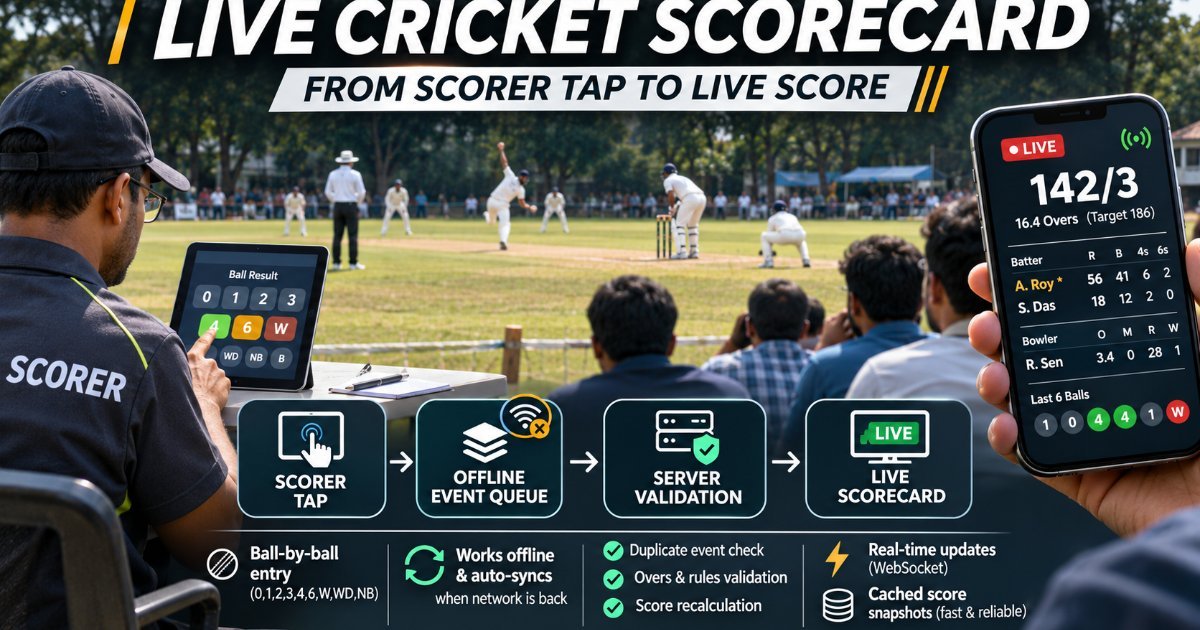
TL;DR: A live cricket score is a data pipeline, not a scoreboard. The scorer records each ball, the app queues it, the server validates it, and fans read a cached view. Accuracy and uptime matter more than animation.
You refresh the scorecard. Two seconds later, the score moves. It feels instant. It is not.
Between the scorer's tap and your phone, a ball passes through a small chain of systems. Each one has a job, and each one can fail in a way that turns a live score into a wrong score.
Step 1: The scorer records the ball
The scorer's app is the front line. It has to be fast enough to use with one hand, clear enough to avoid mistakes, and forgiving enough to undo them.
A good scoring client records events, not just totals: who bowled, who faced, runs, extras, wicket type, and fielding credit. It stores the event locally before sending it. If the ground has no signal, the match continues and the queue waits.
This is called offline-first design. It is the difference between a scoring app that works at a local ground and one that only works in a press box with fibre.
Step 2: The server validates the event
The server should not trust the client's totals. It should receive the event, check it against the rules, and rebuild the match state.
Validation covers the boring questions:
- Was that a legal delivery?
- Do the runs and extras add up?
- Is the batter on strike correct?
- Has the over ended?
- Is the bowler eligible to bowl the next over?
- Does the wicket type match the dismissal?
If an event is invalid, the server rejects it and the scorer corrects it. If two events arrive twice because of a retry, the server should ignore the duplicate. That is why event IDs matter.
Step 3: The match state is derived
There are two common ways to store a match: a snapshot of the current score, or an append-only log of every event.
The log is more useful. The current score is a projection of the log. If a scorer corrects a boundary three overs later, the platform can recompute the score, the batter's stats and the bowler's figures from the log.
This also gives you an audit trail. When a league table looks wrong, you can trace the exact ball that changed it.
Step 4: The score reaches the fan
Fans do not need the event log. They need a fast, readable view.
Most platforms use one of three patterns:
- Polling: the page asks for the latest score every few seconds. Simple, but can be slow and wasteful.
- WebSockets or server-sent events: the server pushes updates. Faster, but more complex to scale.
- Cached snapshots: the server writes a compact score snapshot that a CDN can serve. Great for thousands of fans, less instant for commentary.
The best systems mix them. The scorecard can be cached; the commentary feed can stream. When the network is poor, the page falls back to polling.
Step 5: Stats and standings are recalculated
The scorecard is not the end of the pipeline. Runs, wickets, strike rates, economies and net run rate are all derived from the same events.
That is why a correction has to ripple. If a scorer changes a no-ball to a legal delivery, the batter's runs, the bowler's economy and the points table may all change. A platform that only updates the visible score leaves the stats wrong.
Why offline-first is non-negotiable
Local cricket is played on grounds with weak mobile coverage. A scoring app that requires a stable connection will fail exactly when it is needed.
Offline-first does not mean sync later and hope. It means:
- Every event is stored locally first.
- The queue survives an app restart.
- Duplicate events are handled safely.
- Conflicts are resolved with a clear rule, usually the server's version.
A real product view: WicketNexus
WicketNexus is a league platform that combines live ball-by-ball scoring, scorecards, a points table with NRR, player insights and broadcast overlays. It runs its own franchise league and licenses the same system to other organizers, which is a useful test of whether the pipeline is reusable. You can see the product at wicketnexus.com.
The interesting engineering choice is not any single feature. It is that the scorecard, the standings and the overlay all read from the same match state. That is what makes a live score trustworthy.
What to check before you choose a scoring app
- Offline mode: can the scorer record a full match without a connection?
- Undo and audit: can a mistake be corrected without deleting the match?
- Roles: can a scorer change team registrations? They should not be able to.
- Export: can you get the ball-by-ball data out?
- Latency: how often does the public score refresh?
- Battery: does the app survive a 50-over match on a mid-range phone?
- Support: who do you call when the app fails at 9 a.m. on match day?
Key Takeaways
- A live score is an event pipeline: record, validate, derive, distribute.
- Offline-first scoring is essential for local grounds.
- Server-side validation and an audit trail prevent wrong results.
- Corrections must recalculate stats and standings, not just the visible score.
- Choose a scoring app for reliability and exportability, not just the interface.
Frequently Asked Questions
Can live scoring work without internet?
Yes, if the app stores events locally and syncs later. Ask specifically about offline mode and queue recovery.
Why do some live scores update slowly?
Polling intervals, caching and network quality all add delay. A push-based system is faster but harder to scale.
How are scoring mistakes corrected?
The scorer edits the event, the server recalculates the match state, and derived stats update. A proper audit trail records the change.
How did this story feel?
Be the first to react
Recommended gear
Popular tech picks

Samsung Galaxy S25 Ultra
6.9" AMOLED · 200MP · 5000mAh
Editor's pickView on Amazon →
Apple MacBook Air 13-inch (M4)
M4 · 16GB · 13.6" Liquid Retina
Editor's pickView on Amazon →
Sony WH-1000XM5
Over-ear ANC · 30h battery
Best headphonesView on Amazon →Affiliate links: we may earn a commission at no extra cost to you.
Written by
TechPulse Team
The TechPulse editorial team publishes clear, practical technology guides. Every article is original and written to be understood — not just skimmed.
Comments (0)
No comments yet — start the conversation!
Keep reading

How Core Web Vitals Affect Your Google Rankings
Core Web Vitals are Google's three speed and stability scores. They break ranking ties, not decide them. Here's how to check yours and fix the pages that matter.
Accessible Websites: The Questions Everyone Asks
You don't need a big budget to make a site usable for everyone. Press Tab, fix your contrast, and start with these basics.

Semantic HTML SEO: What a Site Rebuild Taught Me
A site rebuild showed me where semantic HTML actually helps SEO — and where it doesn't. No magic tags, just clearer structure, better accessibility, and sturdier schema.