
The Real Lifespan of Your Home Appliances (Without Going Broke)
Your grandmother's refrigerator lasted 30 years. Yours might be lucky to see a decade. That's not nostalgia talking — it's the reality of modern appliance manufacturing, and it's costing you thousands.
Here's the good news: knowing what you're actually buying (and how to care for it) can stretch your budget further than any extended warranty ever will. Let's talk about what "home appliance lifespan" really means in 2025, and how to make smart choices when money's tight.
How Long Do Appliances Actually Last? The Honest Numbers
Most manufacturers won't tell you this upfront, but industry data gives us a pretty clear picture. American homes see major appliances replaced every 10-12 years on average, but that number hides a lot of variation.
Here's what you're realistically looking at:
| Appliance | Expected Lifespan | Budget-Friendly Reality |
|---|---|---|
| Refrigerator | 13-17 years | 10-14 years (budget models) |
| Washing machine | 10-13 years | 8-11 years |
| Dryer | 10-13 years | 9-12 years |
| Dishwasher | 9-12 years | 7-10 years |
| Microwave | 7-10 years | 5-8 years |
| Water heater | 8-12 years | 6-10 years |
Note the pattern? Budget appliances tend to die 15-25% sooner than mid-range models. That's the trade-off you're making.
Repair or Replace? The Rule That Saves You Money
When your washer starts screaming during spin cycles, you need a decision framework — not panic.
The 50% rule: If a repair costs more than half what you paid for the appliance, and the appliance is past 50% of its expected lifespan, replace it. Simple math.
But here's the nuance most people miss. A $150 repair on a 7-year-old dryer that should last 12 years? Fix it. That's $150 spread over 5 more years — way cheaper than $800 for a new one.
The exception: refrigerators. Modern fridges have sealed systems that are expensive to repair. A $400 compressor issue on a 10-year-old unit usually means it's time to shop.
Budget Brands That Punch Above Their Weight
You don't need to finance a Sub-Zero to get a fridge that lasts. Here's where I'd put your money:
Amana — American-built, no-frills, and surprisingly durable. The Amana ART308FFDW (around $650-750) gets consistently solid reliability reviews. You're paying for function, not Instagram aesthetics.
LG — Their top-load washers have a strong track record. The LG WT7005CW (around $700-800) has fewer bells than the front-loaders but fewer failure points too. (Skip their smart features — you don't need your washer connected to WiFi.)
Whirlpool's entry lines — The brand has slipped slightly in recent years, but their basic models are still workhorses. Look at their 4.5 cu. ft. top-loaders in the $600-700 range.
Bosch dishwashers — Not budget, but not luxury either. A $550-650 Bosch 300 Series will outlast nearly any $400 Frigidaire or $350 Amana. This is the one category where I'd say spend a little more upfront.
What to avoid on a budget: Samsung and LG refrigerators (known compressor issues), anything with a touchscreen or WiFi connectivity, and brands you've never heard of that only exist on Amazon.
The Simple Maintenance Habits That Double Lifespan
Want to make appliances last longer? Boring habits beat fancy features. Every time.
Clean your refrigerator coils. Twice a year. Pull the fridge out, vacuum the coils, and you'll add years of compressor life. Most people never do this. Most people also replace their fridges too soon.
Stop overloading your washer. That "extra-large capacity" means extra strain on the drum bearing. Fill it three-quarters full. Your machine will thank you.
Run your dishwasher's hot water line first. Before starting a cycle, run the kitchen tap until it's hot. This gets hot water to the dishwasher immediately instead of heating cold water for 20 minutes. Less wear on the heating element.
Replace water filters on schedule. Cheap insurance against sediment buildup. This applies to fridges, water heaters, and that under-sink filter you installed and forgot about.
Don't ignore strange sounds. That grinding noise from your dryer isn't normal. A $15 belt replacement now beats a $200 motor repair later. Open YouTube and fix it yourself — these are more repairable than you think.
The Right-to-Repair Factor: Why Your Next Appliance Might Last Longer
Here's something worth watching. The right-to-repair movement is gaining real traction, and it directly affects your appliance's longevity.
Massachusetts passed strong right-to-repair laws in 2020 (implementation has been delayed by auto industry lawsuits, but the principle stands). In 2023, Louisiana passed similar legislation. When you can actually buy replacement parts and get repair manuals, you can fix things yourself — or afford a local repair shop's rates instead of the manufacturer's.
Translation: appliances with accessible parts and straightforward diagnostics last longer in real-world use. Before buying, search "[model name] repair" on YouTube. If there are three videos showing common fixes, that's a good sign. If there's nothing, you're buying a disposable product.
Key Takeaways
- Budget appliances typically last 15-25% shorter than mid-range models — factor this into your purchase math.
- Use the 50% rule: if repair costs exceed half the purchase price and you're past half the expected lifespan, replace it.
- Clean refrigerator coils twice a year. It's free and adds years to the compressor.
- Avoid smart features and touchscreens on budget appliances — more failure points, more money to fix.
- Check YouTube for repair videos before buying any appliance. Parts availability and community support matter.
- Bosch dishwashers are worth the extra $150-200. Their reliability record justifies the stretch.
Frequently Asked Questions
How long should a refrigerator last in 2025?
Is it better to repair or replace a 10-year-old washing machine?
Do expensive appliances last longer than budget ones?
How did this story feel?
Be the first to react
Recommended gear
Related picks for this guide

Dreame L10s Ultra
5300Pa · self-empty · mop wash
Best robot vacuumView on Amazon →
Levoit Core 300S
HEPA H13 · 219 ft² · 24dB
Quiet pickView on Amazon →
Philips Airfryer XXL
7.3L · Rapid Air · 2225W
Best for familiesView on Amazon →Affiliate links: we may earn a commission at no extra cost to you.
Written by
TechPulse Team
The TechPulse editorial team publishes clear, practical technology guides. Every article is original and written to be understood — not just skimmed.
Comments (0)
No comments yet — start the conversation!
Keep reading

Standby Power Audit: Find What's Wasting Money
That red light on your TV is costing you money. Here's how to measure standby power at home in an hour, and which devices are actually worth unplugging.

Cheap Appliances: The Bills That Show Up Later
That ₹16,000 washing machine might cost you more than the ₹27,000 one. Here's where cheap appliances quietly bill you later.
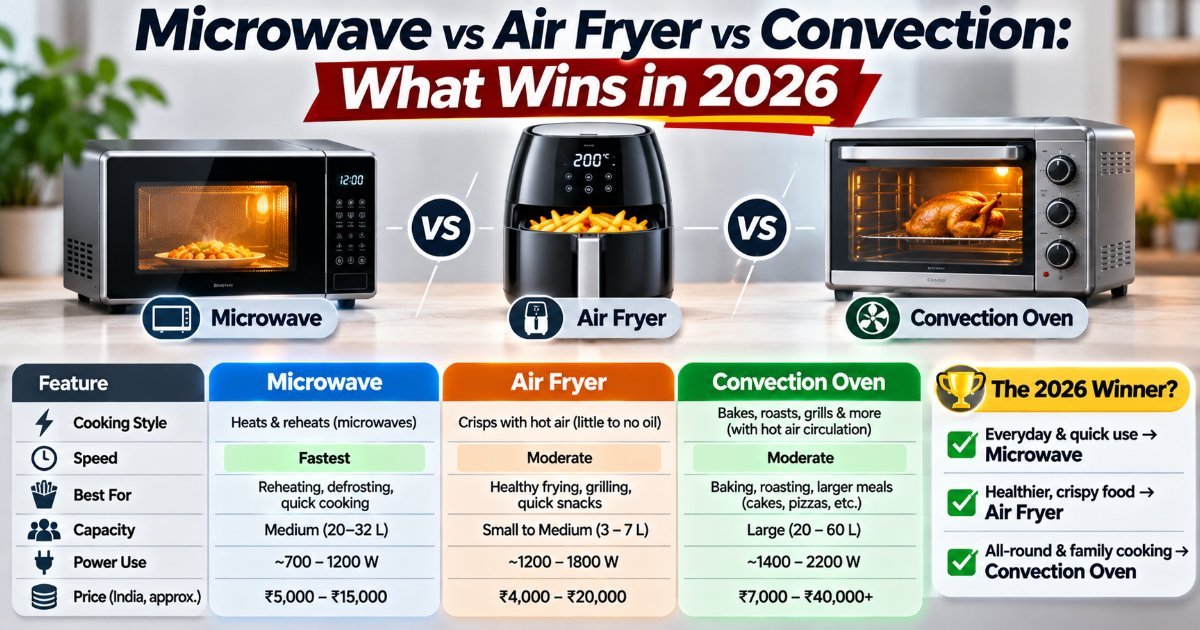
Microwave vs Air Fryer vs Convection: What Wins in 2026
Three appliances, one countertop, and a lot of overlap. Here's what each one genuinely does best in 2026 — and the combo you should probably skip.