Why Phones Overheat in 2026 — and When to Worry
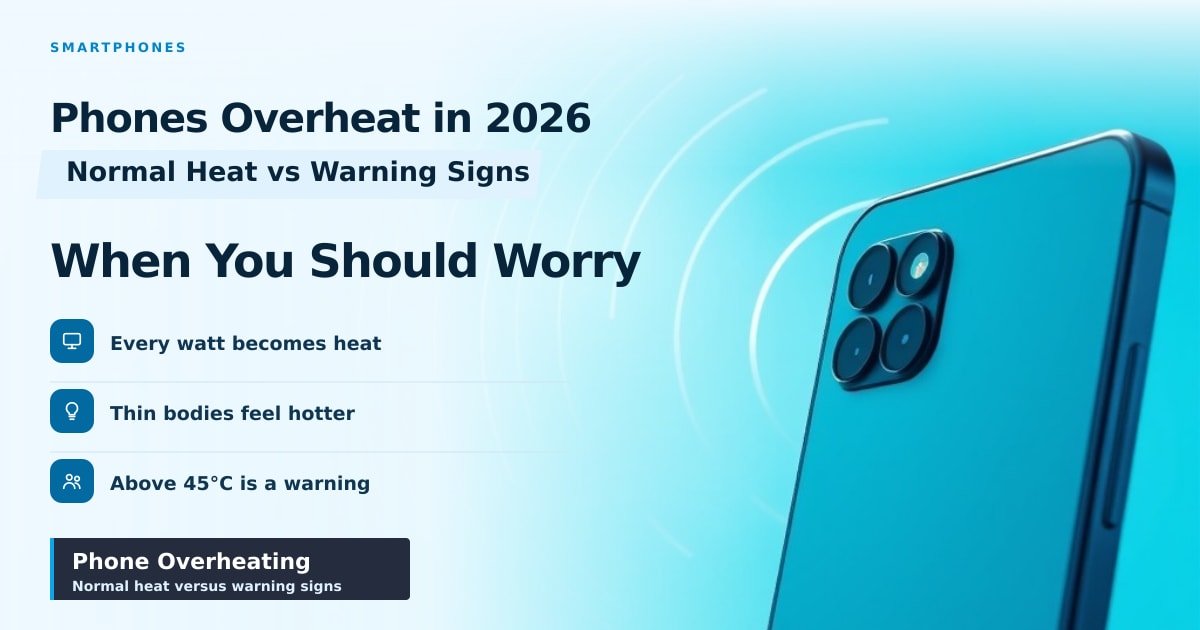
TL;DR: Phones overheat because every watt they use turns into heat, and 2026's thinner bodies with bigger batteries make that warmth easier to feel. A hot phone is usually fine. It's a real problem only above about 45°C, when it keeps slowing itself down, or when the battery starts to swell.
Twenty minutes into a video call on a hot afternoon, the metal edge of your phone starts to feel like a mug of chai. Nothing is broken. That warmth is the one thing phone makers can't design away: every watt the phone uses becomes heat, and there's nowhere for it to go. Here's why phones overheat in 2026, and where normal ends and a real problem starts.
Why phones overheat: where the heat comes from
Every phone turns electricity into heat. There's no exhaust pipe, so the heat leaves through the glass and metal you're holding. Three parts do most of the work: the processor (the chip that runs apps and games), the battery (charging and draining), and the screen plus radios (display, Wi-Fi, mobile signal).
The harder the job, the more heat. A game pushes the processor flat out for an hour. A 4K video records non-stop. A video call runs the camera, screen, Wi-Fi and microphone together. Even GPS in a car mount adds sunlight through the windscreen. A phone gaming hard can burn 5 to 8 watts, which is a small LED bulb's worth of heat trapped in a slab in your hand.
What changed in 2026
Three design shifts made heat more noticeable this year.
Thin is back. Phones like the iPhone Air and Galaxy S25 Edge pushed bodies under 6mm. Slim phones have less air inside to spread heat, so the same chip feels hotter in your palm.
Batteries got denser. Makers swapped some graphite for silicon in the battery, which packs more energy into the same space. That's how you get 6,000mAh (enough for a full day of maps, photos and scrolling) inside an 8mm phone. The catch: filling a bigger battery at 100W makes more heat, faster.
AI moved onto the phone. Photo clean-up, live translation and voice assistants now lean on the NPU, a chip built for AI maths. Those jobs run for minutes, not milliseconds, so the chip stays hot instead of cooling between taps.
The good news is that cooling hardware improved too. Most 2026 flagships use a vapor chamber, a sealed metal pad with a little fluid inside that spreads heat across the whole body. Apple added one to the iPhone 17 Pro.
When heat is actually a problem
Most warmth is designed, not a fault. Phone makers aim to keep the outside below roughly 40–43°C. Past that, the phone slows the chip down on purpose, called thermal throttling, so it doesn't cook itself. That's why a game drops frames after 20 minutes, or the camera stops recording with a temperature warning.
Treat these as real warning signs:
- The battery area stays above about 45°C, or charging stops with a heat warning.
- The phone is hot while sitting idle on a table. That's usually one misbehaving app.
- The back cover bulges or the screen lifts at the edges. Stop using it. A swelling battery is a fire risk, not a nuisance.
- It shuts down or restarts on its own during normal use.
What to do when your phone runs hot
- Take the case off for fast charging and gaming. A thick case is a blanket.
- Never charge it under a pillow, on a bed, or on a car dashboard in the sun.
- Use bypass charging if your phone offers it. When plugged in, the charger powers the phone directly, so the battery isn't heating up while you play.
- Turn on the 80% charge limit for overnight charging. Full charge plus high heat ages a battery fastest.
- Skip the fridge or freezer. Condensation inside does more damage than the heat.
My honest advice: if you game or shoot long videos, buy the thicker phone with the bigger vapor chamber. Heat, more than age, is what kills batteries early.
Key Takeaways
- Warm after gaming, charging or a video call is normal, because power becomes heat.
- Thinner bodies and bigger batteries in 2026 make that heat easier to feel.
- Anything above 45°C, a swelling back, or constant slowdowns is a genuine warning sign.
- Heat wears out your battery faster than time does.
Frequently Asked Questions
Is it normal for my phone to get hot while charging?
Yes, especially with fast charging, because the first half of the charge produces the most heat. It's only a problem if charging stops with a temperature warning or the phone stays hot after you unplug it.
At what temperature should I worry about my phone overheating?
Above about 45°C at the battery, or whenever you see a "phone too hot" message on screen. Below that, warmth is the phone doing its job.
Why is my phone hot when I'm not using it?
Usually an app stuck in the background, such as a backup, a sync or a game left running. Open battery settings and check which app sits at the top of the list.
Sources
How did this story feel?
Be the first to react
AI assistance. This article was researched and drafted with AI tools and reviewed by our editorial team before publication. We link to sources at the end of every article so you can verify the claims. If you spot an error, please let us know.
Recommended gear
Related picks for this guide

Samsung Galaxy S25 Ultra
6.9" AMOLED · 200MP · 5000mAh
Editor's pickView on Amazon →
Google Pixel 9a
6.3" OLED · Tensor G4 · 7-year updates
Best valueView on Amazon →Affiliate links: we may earn a commission at no extra cost to you.
More on #smartphones
Weekly tech brief
The tech stories worth your time, every Sunday.
One short email with the most useful guides and gadget picks from the week. No spam, unsubscribe anytime.
Written by
TechPulse TeamThe TechPulse editorial team publishes clear, practical technology guides. Every article is original and written to be understood — not just skimmed. Read our editorial policy.
Comments (0)
No comments yet — start the conversation!
Keep reading
IP68 Rating: What It Really Protects Against
That IP68 label on your phone covers rain and the sink, not the pool. Here's what the test really checks, and why water damage still isn't covered.
eSIM for Travel: A Dual SIM Setup That Cuts Roaming Bills
I ran a dual SIM plus travel eSIM setup for nine days in Europe and paid $19 for data instead of daily roaming fees. Here's the exact setup.
How to Test a Used Phone Before You Pay for It
A used phone can look perfect and still be a money pit. Here's the 15-minute test — IMEI, battery, screen and cameras — that saves you the repair bill.