IP68 Rating: What It Really Protects Against
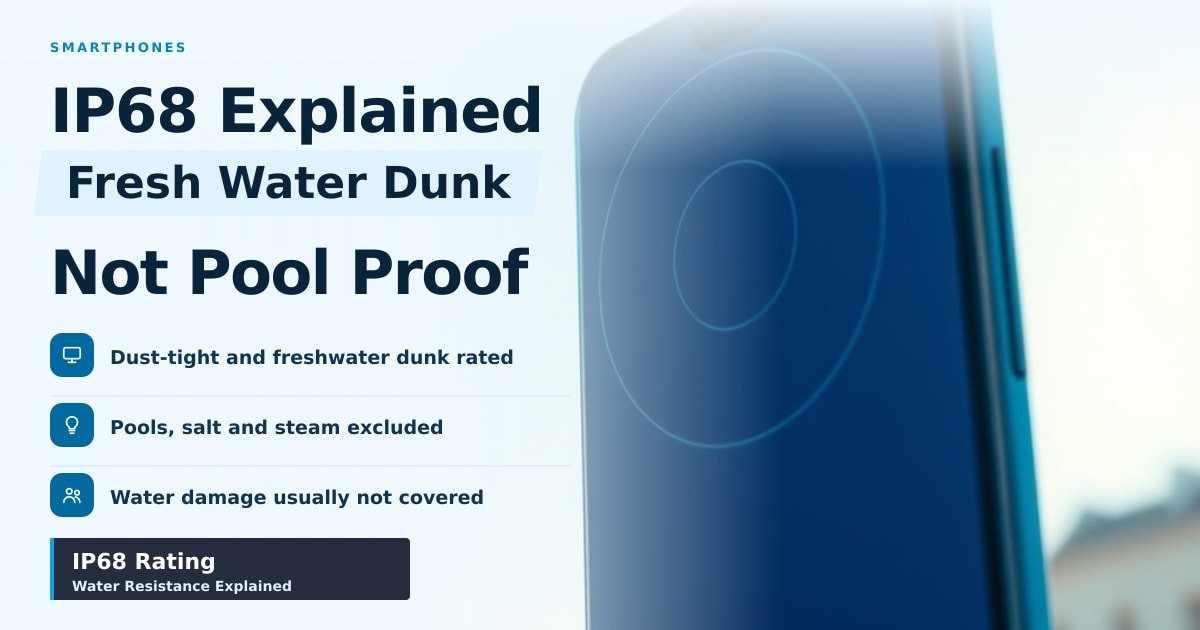
TL;DR: An IP68 rating means your phone is fully sealed against dust and can survive a dunk in roughly 1.5 metres of fresh water for up to 30 minutes. It does not cover pools, sea water, hot showers or steam. And in most cases, water damage still isn't covered by your warranty.
In a testing lab, a phone gets lowered into a tank of room-temperature fresh water and left there for 30 minutes. That test is where the "8" on the box of a Galaxy S25 or an iPhone 16 comes from. Your swimming pool, with chlorine in the water and a one-metre drop before the splash, is a different story.
What the two numbers in the IP68 rating actually mean
IP stands for Ingress Protection, which is just a fancy way of saying "how well the case keeps stuff out." The first digit covers solids, the second covers liquids.
- 6 (solids): dust-tight. Nothing gets in, even after hours in a gritty gym bag.
- 8 (liquids): survives being fully underwater. The phone maker picks the depth and time, but the standard requires at least 1 metre for 30 minutes.
Here's the part people miss: IP68 isn't one fixed test. Samsung rates the Galaxy S25 at 1.5 metres for 30 minutes. Apple rates the iPhone 16 at 6 metres for 30 minutes. Same label, four times the depth.
What IP68 protects against, and what it doesn't
Think of it as cover for the boring accidents. Rain on a walk to the car, a splash at the sink, a glass of water knocked across the table, a dusty pocket on a hike. Those are the cases the rating was built for.
It does not protect against:
- Salt water and chlorine. Neither is used in the test, and both eat away at seals and charging pins.
- Hot water and steam. Steam gets past seals that hold cold water fine. Skip the sauna and the shower.
- Soap and shampoo. They lower water's surface tension, so it creeps into gaps that plain water can't.
- Pressure jets. A power washer or a strong tap is a separate rating (IPX9K) that most phones don't have.
- Drops. Nothing about IP68 says the glass survives the fall before the splash.
One more catch: the phone is tested brand new. Seals soften with heat and wear out over two or three years. A cracked back panel ends your water resistance instantly.
IP68 vs IP67: is the higher number worth paying for?
IP67 means 1 metre for 30 minutes. IP68 means at least that, usually more. In daily life, both cover the same "oops" moments. The gap only matters if you film underwater or work outside in heavy rain all day.
So don't pay extra for the 8 alone. Check the fine print instead, because a budget phone's IP68 and an iPhone's IP68 are not the same promise.
What this means for you
- Buy IP67 or IP68 for peace of mind. It handles the sink, the rain and the spilled coffee, which is most of what actually happens.
- Don't swim with it. No mainstream phone warranty covers salt water or chlorine damage, IP68 or not.
- If it gets wet, don't charge it. Wipe it down, shake out the port, and wait for any moisture warning to clear. Charging a damp port is how corrosion starts.
- Treat a case as drop protection, not water protection. A case doesn't add water resistance, though it does stop the cracked glass that would destroy it.
Key Takeaways
- IP68 means dust-tight plus underwater survival, usually 1.5 metres for 30 minutes.
- The test uses still, fresh, room-temperature water, not pools, sea or showers.
- The same IP68 label hides very different depth limits between brands.
- Water damage is normally excluded from warranty, so treat the rating as a safety net.
Frequently Asked Questions
Is IP68 completely waterproof?
No. Nothing in phones is truly waterproof, only water-resistant up to a tested limit. IP68 means it survives a shallow freshwater dunk, not a swim.
Can I take my IP68 phone into the pool or the sea?
Avoid it. Chlorine and salt aren't part of the test, and they corrode seals and charging pins faster than fresh water does.
Does water damage void my warranty?
Usually yes. Apple and Samsung both exclude liquid damage from standard warranties, even on phones sold with an IP68 rating.
Sources
- IP Code — Wikipedia: https://en.wikipedia.org/wiki/IP_code
- iPhone 16 technical specifications — Apple: https://www.apple.com/iphone-16/specs/
- Galaxy S25 specifications — Samsung: https://www.samsung.com/in/smartphones/galaxy-s25/specs/
How did this story feel?
Be the first to react
AI assistance. This article was researched and drafted with AI tools and reviewed by our editorial team before publication. We link to sources at the end of every article so you can verify the claims. If you spot an error, please let us know.
Recommended gear
Related picks for this guide
Samsung Galaxy S25 Ultra
6.9" AMOLED · 200MP · 5000mAh
Editor's pickView on Amazon →
Google Pixel 9a
6.3" OLED · Tensor G4 · 7-year updates
Best valueView on Amazon →Affiliate links: we may earn a commission at no extra cost to you.
Weekly tech brief
The tech stories worth your time, every Sunday.
One short email with the most useful guides and gadget picks from the week. No spam, unsubscribe anytime.
Written by
TechPulse TeamThe TechPulse editorial team publishes clear, practical technology guides. Every article is original and written to be understood — not just skimmed. Read our editorial policy.
Comments (0)
No comments yet — start the conversation!
Keep reading
Why Phones Overheat in 2026 — and When to Worry
Your phone getting warm is normal. Here's what changed in 2026, and the signs that heat has turned into a real problem.
eSIM for Travel: A Dual SIM Setup That Cuts Roaming Bills
I ran a dual SIM plus travel eSIM setup for nine days in Europe and paid $19 for data instead of daily roaming fees. Here's the exact setup.
How to Test a Used Phone Before You Pay for It
A used phone can look perfect and still be a money pit. Here's the 15-minute test — IMEI, battery, screen and cameras — that saves you the repair bill.