
Feature Flags: Cheap Insurance for Every Release
The deploy went green. The outage started eleven minutes later.
That's the part nobody puts in the slide deck: your tests passed, your build passed, and a customer still hit a code path QA never touched. Rollback took twenty minutes. The postmortem took two weeks. What would have saved you wasn't better testing. It was feature flags — a way to ship the code without shipping the behavior.
What feature flags actually change about shipping
A feature flag wraps a code path in a runtime check. Deploy the code, leave the flag off, and nothing changes for anyone. Turn it on for one internal account, then 2% of users, then everyone. That's it. Simple idea, slightly boring, enormous consequences.
Three things fall out of that:
- Blast radius becomes a dial, not a dice roll. You choose who sees the change instead of hoping staging resembled production.
- Rollback stops being a redeploy. Flip a toggle. No build queue, no version dance, no praying the previous container image still exists.
- Deploy and release stop being the same event. This is the one people underestimate. Once merging to main doesn't mean "customers see it," trunk-based development gets a lot less scary.
Here's my honest opinion after watching a lot of teams do this: rollback is not a strategy. It's a panic button. If your only recovery move is reverting a commit under pressure, you don't actually know what broke — you're just removing the crime scene.
The trends that actually matter
OpenFeature is making flags infrastructure, not a product
OpenFeature, now a CNCF project, defines a vendor-neutral SDK spec for flag evaluation. The pitch is simple: code against one interface, swap providers later without touching a hundred call sites.
That's genuinely useful, especially if you've got services in three languages plus a pile of edge workers. My caution: a standard interface doesn't give you governance. You can standardize your way into four hundred orphans just as easily as you can vendor your way there.
Progressive delivery and observability are merging
The interesting work isn't the flag itself anymore — it's what decides the flag. Teams are wiring rollout percentages to live metrics: error rate, p95 latency, saturation. If the canary degrades, the rollout halts on its own.
Argo Rollouts and Flagger handle the traffic-shifting side on Kubernetes; flags handle targeting inside the app. The mental model to keep: the flag is the control, the metric is the decision. Automate the pair and your Friday deploys stop being an act of faith.
Experimentation and release tooling are the same market now
OpenAI bought Statsig in 2025. Harness bought Split in 2024. Whatever you think of those deals, they tell you something: flags and experimentation are converging into one category, because the same toggle that gates a release can carry an A/B test.
Which is convenient, and also a trap. Don't run an experiment on a release flag without a sample-size plan written down first. You'll p-hack your way to a very confident, very wrong answer (I've watched it happen twice).
Flag debt became a real problem
Everyone who adopted flags during the 2020–2022 hiring boom now has a few hundred of them and no idea which are dead. The industry response is slowly getting sensible: flag inventories, staleness detection through code scanning, expiry dates as a first-class field, cleanup as part of the definition of done.
A flag with no owner and no expiry date is a bug you haven't filed yet. That's not a metaphor — it's the same risk profile as a dead if branch, except this one can be flipped on by a stranger at 2am.
Kill switches are drifting into compliance
Operational resilience rules (DORA in the EU financial sector, for instance) push toward demonstrable ability to disable a feature fast. That changes tool selection: emergency controls need audit logs, role-based access and an approval trail. A kill switch that any engineer can flip with no record is an incident waiting for a regulator.
Picking a tool without overthinking it
| Tool | Where it fits | Heads-up |
|---|---|---|
| LaunchDarkly | Mature SaaS, strong targeting, good for orgs that want support | Pricing scales with seats and MAU — check before you demo it to everyone |
| Unleash | Open source core, self-host friendly | You own the uptime and the upgrades |
| Flagsmith | Open source with a hosted option, decent middle ground | Smaller ecosystem than the leaders |
| GrowthBook | Warehouse-native experimentation | Leans experiment-first, release-gating second |
| AWS AppConfig | Already deep in AWS | Config-first; less of a product around flag lifecycle |
Pricing and tiers move constantly, so treat that table as a starting point, not a quote. And don't pick on features alone — pick on whether the tool makes stale flags visible. That's the failure mode you'll actually hit.
Four rules that keep flags from becoming a mess
- Separate flag types. Release flags live days. Experiment flags live weeks. Operational kill switches live forever. Different lifespans, different review rules — treat them that way.
- Name them for strangers.
release-checkout-v2beatsnew_thingevery time. Six months from now you won't remember whatnew_thingdid. - Test both paths. Ship a flag and only ever test the "on" branch, and you've built a code path that's broken for 2% of users. Keep nesting to two flags maximum; three is where reasoning breaks down.
- Attach an owner and a date. If a flag hits its expiry, it's a ticket, not a note in Slack.
And if you find yourself flagging every single change? That's not a flag problem. That's a sign your merge cadence is too slow or your modules are too tangled. Flags buy you time; they don't fix architecture.
Key Takeaways
- Feature flags separate deploy from release, which shrinks the blast radius of any change.
- The useful trends are OpenFeature standardization, metric-driven progressive delivery, and flag lifecycle management — not more toggle types.
- Flag debt is real and boring: no owner plus no expiry date equals future incident.
- Test both flag paths in CI, or you're shipping untested branches to real users.
- Kill switches are becoming audit-sensitive; check RBAC and logging before you standardize on a tool.
- Flags won't rescue a broken architecture. Fix the fundamental, then use flags for the risky 10%.
Frequently Asked Questions
Are feature flags worth it for a small team?
Yes, if you keep them few and boring. A team of five with one release flag on checkout and one kill switch for payments gets most of the benefit. The overhead arrives when flags outnumber the people who understand them.
What is feature flag debt?
It's the accumulated pile of stale, undocumented toggles still wrapped around your code. It slows onboarding, confuses incident response, and hides dead code paths that nobody tests. The fix is mundane: expiry dates, owners and automated staleness reports.
Open source feature flag tools or paid SaaS — which should I pick?
Self-hosted open source wins if you have platform engineers and strict data rules. Paid SaaS wins if you'd rather buy uptime and support than run another stateful service. Either way, evaluate the cleanup workflow first — that's what you'll live with daily.
Do feature flags slow down my app?
A local evaluation is a memory lookup, so the cost is negligible. The real latency appears when every flag check calls a remote API from inside a request. Use SDKs that cache locally and stream updates instead.
How did this story feel?
Be the first to react
Written by
TechPulse Team
The TechPulse editorial team publishes clear, practical technology guides. Every article is original and written to be understood — not just skimmed.
Comments (0)
No comments yet — start the conversation!
Keep reading
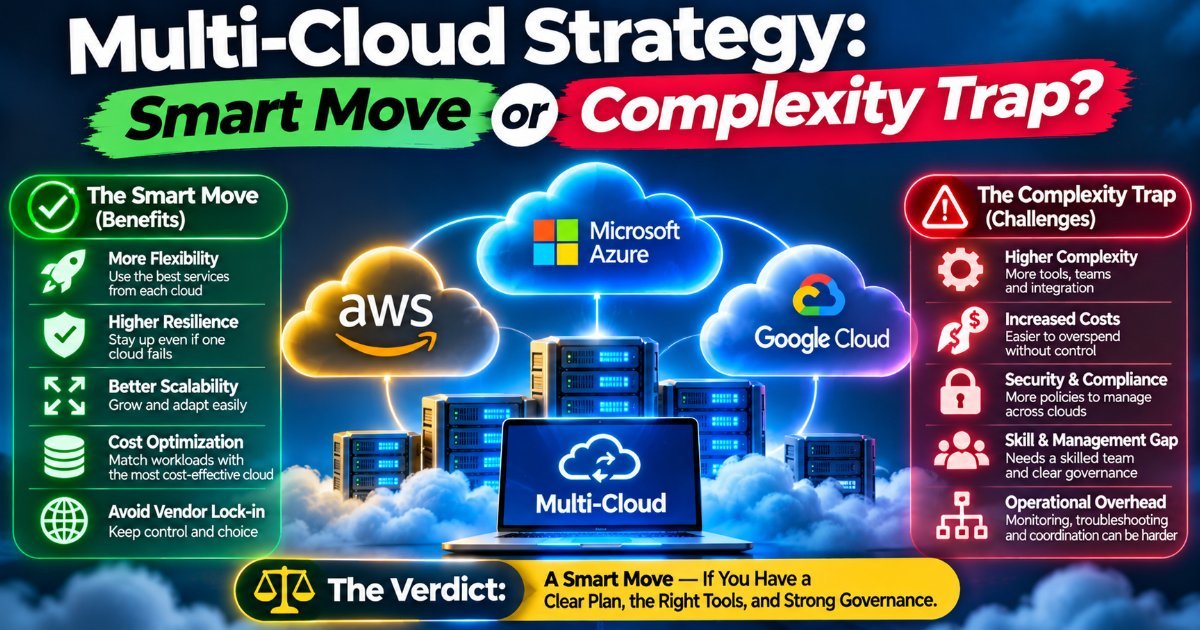
Multi-Cloud Strategy: Smart Move or Complexity Trap?
Multi-cloud is either leverage or a very expensive habit. Here's how to tell which one you're building — and what the egress fee and VMware shake-ups actually change.
OpenTelemetry Observability, Minus the Hype
Real teams, real Collector configs, real bills. A practical look at what OpenTelemetry fixed, what it didn't, and where observability goes next.
Multi-Cloud Strategy: The Complete Checklist Before You Commit
Multi-cloud isn't for everyone. Our checklist shows when it pays off — and when it's a complexity trap that costs you money and sleep.