
Multi-Cloud Strategy: Smart Move or Complexity Trap?
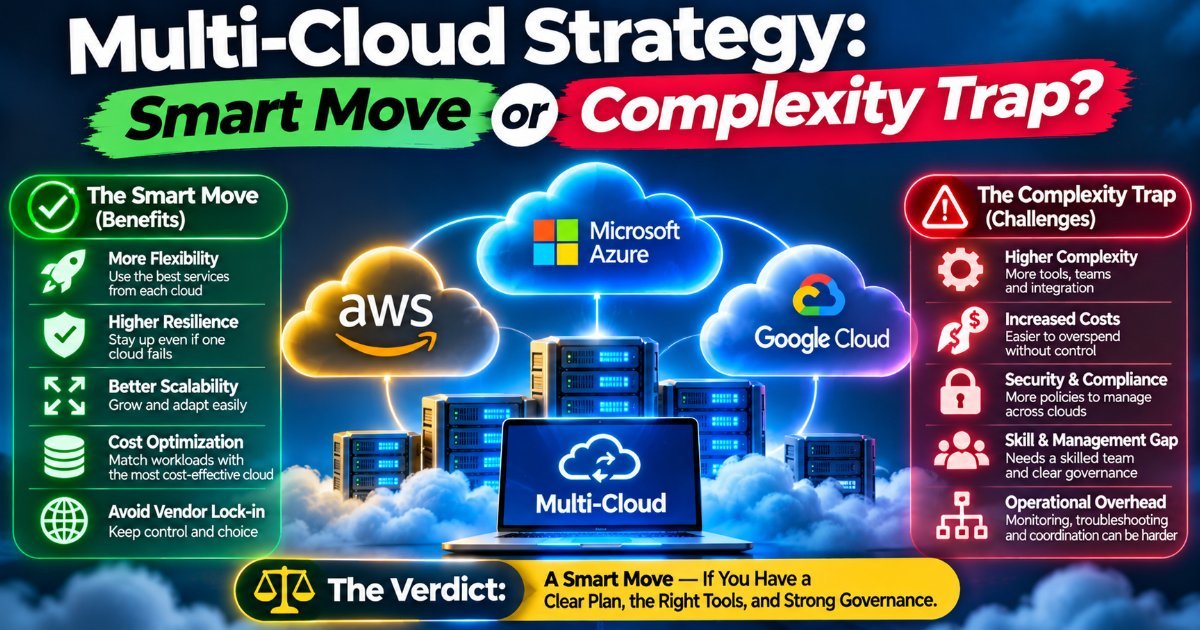
A platform team I worked with ran the same Node service in AWS and Azure for two years, “for resilience.” Last spring they quietly killed the Azure copy. Nobody noticed for six weeks. That's the multi-cloud story in miniature — the disaster you plan for rarely arrives, but the bill and the on-call rotation show up every month without fail.
So is a multi-cloud strategy genuinely smart, or are you buying complexity with a nice slide deck? The honest answer depends on which problem you're actually solving. Let's dig into what the recent trends mean for your team, and where I'd draw the line.
What “Multi-Cloud” Actually Means Now
Most survey headlines claim 85–90% of enterprises run multi-cloud. Dig into the methodology and a lot of that is “two hyperscalers plus Salesforce plus a SaaS observability tool.” That's not a strategy. That's Tuesday.
Three terms get mashed together constantly:
- Multi-cloud: two or more independent cloud providers running meaningful workloads.
- Hybrid cloud: a mix of public cloud and your own data center or private cloud (often VMware-based).
- Multi-region: one provider, multiple geographic regions. Cheapest resilience you can buy.
That last one matters. If your real goal is surviving an outage, multi-region inside a single provider usually gets you there for a fraction of the operational cost. Multi-cloud only earns its keep when the second provider solves a problem the first one structurally can't.
Where a Multi-Cloud Strategy Actually Pays Off
I'm not anti-multi-cloud. There are genuinely good reasons to run two providers, and they're more specific than most vendor blogs admit.
Regulation and data residency. Some workloads have to live in a specific jurisdiction or a specific sovereign cloud. If a regulator, not an architect, drew your topology, follow the regulator.
Mergers and acquisitions. You acquire a company that runs everything on Google Cloud. Ripping it out in year one is how you burn out two engineering teams. Run it, connect it, migrate on your timeline.
A genuinely better service for one job. BigQuery for analytics, Azure for Microsoft 365 and Entra ID integration, AWS for the bulk of your application estate. Refusing to use the best tool for a narrow, well-bounded problem is its own kind of dogma.
Negotiating leverage that you actually use. Two providers with real spend gives your procurement team something to work with. One provider with a three-year commitment and a renewal in eight weeks does not.
Notice what's missing from that list: “avoid vendor lock-in” as a blanket goal. Lock-in is a spectrum, and portability you never exercise is just a tax you volunteered for.
The Complexity Tax, Itemized
Here's where the trap closes. Every cost below is real, and almost none of them show up in the business case.
- Egress fees. Moving data between clouds or back to you costs roughly $0.09 per gigabyte at list price on the big three. Cross-cloud traffic for a data-heavy workload can quietly exceed the compute bill.
- Commitment discounts don't travel. Savings Plans, Reserved Instances, and Committed Use Discounts can cut 40–70% off compute — and they're locked to one provider. Split your workloads and you split your discount leverage, which often wipes out the “competitive pricing” you were chasing.
- Identity sprawl. Two IAM models, two sets of roles, two audit trails. Federating them is doable. Keeping the federation correct as people join and leave is a permanent job.
- Skill dilution. Your best SRE knows one cloud deeply and the other adequately. Adequate is where incidents live.
- Tooling duplication. Two sets of IaC modules, two policy engines, two cost dashboards, two sets of quotas to request. Now multiply by every team.
| Question | Single provider (multi-region) | True multi-cloud |
|---|---|---|
| Survives a regional outage | Yes | Yes |
| Survives a provider-wide account failure | Partly | Yes |
| Portable commitment discounts | N/A | No |
| Operational overhead | Moderate | High |
| Best-of-breed per workload | Limited | Yes |
| Realistic for a team under 20 engineers | Yes | Rarely |
That last row is the one I'd underline. Multi-cloud is an organizational capability, not a purchasing decision. If you don't have a platform team that can own two runtimes, you're not running multi-cloud — it's running you.
What the Trends Are Actually Telling You
The economics shifted in your favor recently, and that's worth understanding.
Egress fees are coming down. Google Cloud stopped charging for data transfer when customers leave. AWS followed in 2024 with a similar waiver for customers migrating off. The EU Data Act's cloud-switching rules started applying in late 2025, with switching charges phased out by 2027. Translation: the “exit fee” argument for staying put is weaker than it was, but this doesn't make running two clouds cheaper — it makes leaving one cheaper.
The VMware shake-up pushed a lot of hybrid decisions. Broadcom's licensing overhaul after the 2023 acquisition sent plenty of teams re-evaluating their private cloud estate. Some moved to public cloud, some to alternatives like Nutanix or Proxmox. Either way, “hybrid” stopped being a buzzword and became a budget line.
Abstraction layers matured, and so did the hype around them. Kubernetes, Terraform (now under IBM after the HashiCorp acquisition), Crossplane, Azure Arc, and Anthos can genuinely reduce per-cloud toil. They cannot make two clouds behave like one product. Anyone telling you otherwise is selling a platform.
“Cloud repatriation” is overblown, with a real core. The headlines say everyone's moving back on-prem. They aren't. But steady-state, predictable workloads — CI runners, internal tools, some databases — often run cheaper on your own hardware. Know which of your workloads is which.
How I'd Actually Decide
Three questions, in order. Answer them honestly and the architecture mostly picks itself.
- Can you name the specific failure a second cloud prevents? “Resilience” isn't an answer. “Our regulator requires EU-only processing and provider B has the certification we need” is.
- Do you have a platform team that can own two runtimes without dropping the first? If not, fix that before you add a cloud.
- What's the fully loaded cost, including people? Not the compute invoice. The headcount, the training, the duplicated tooling, the lost commitment discounts.
If you're already in it, here's what keeps it sane: pick a primary provider for anything that isn't legally or technically forced elsewhere. Standardize on Kubernetes and one IaC toolchain so the second cloud is a config target, not a second skill tree. Centralize identity through one IdP. Put every resource behind a cost tag with the owning team's name on it. And review the second cloud every year — if nobody can explain why a workload lives there, that workload is a migration candidate.
Key Takeaways
- Most “multi-cloud” adoption statistics count SaaS, not two real cloud runtimes — check what you're actually running.
- Multi-region inside one provider usually buys you the resilience you wanted, at a fraction of the operational cost.
- Split workloads mean split commitment discounts, and that often erases the pricing advantage you were chasing.
- Egress fee waivers and the EU Data Act make leaving a cloud cheaper, not running two of them.
- Multi-cloud is a staffing and platform-engineering decision first, an architecture decision second.
- Give every cloud resource a cost tag with an owner, or your second cloud becomes an unaudited line item.
Frequently Asked Questions
Is multi-cloud worth it for a small engineering team?
Usually not, unless a regulation or an acquisition forces your hand. A team under 20 engineers is better off going deep on one provider, using multiple regions for resilience, and investing the saved overhead in observability and incident response. Multi-cloud multiplies the surface area you have to be good at.
What's the difference between multi-cloud and hybrid cloud?
Multi-cloud means two or more public cloud providers. Hybrid cloud means combining public cloud with your own data center or private cloud. They overlap — plenty of companies run AWS, Azure, and a VMware estate — but the tradeoffs are different. Hybrid is usually about where the data legally or economically has to live.
Does multi-cloud actually save money?
Rarely on its own. The savings come from negotiation leverage and picking a cheaper provider for a specific workload. Against that you're paying for duplicated tooling, diluted commitment discounts, and extra egress. Most teams that save money do it by consolidating first and negotiating second — not by spreading spend across three vendors.
How did this story feel?
Be the first to react
Written by
TechPulse Team
The TechPulse editorial team publishes clear, practical technology guides. Every article is original and written to be understood — not just skimmed.
Comments (0)
No comments yet — start the conversation!
Keep reading

Feature Flags: Cheap Insurance for Every Release
Feature flags aren't about toggles — they're about shrinking the blast radius of every change. Here's what the current trends mean in practice.
OpenTelemetry Observability, Minus the Hype
Real teams, real Collector configs, real bills. A practical look at what OpenTelemetry fixed, what it didn't, and where observability goes next.
Multi-Cloud Strategy: The Complete Checklist Before You Commit
Multi-cloud isn't for everyone. Our checklist shows when it pays off — and when it's a complexity trap that costs you money and sleep.